01 · THE MACHINEWhat Zhaozhou is
Zhaozhou is a console architecture aimed at real, fabricated silicon: a physical machine of its own. The working proving ground along the way is an FPGA core for the SuperStation One, a MiSTer-family board built around a Cyclone V FPGA. That core is a step on the road, not the destination. It is not a miniature PC graphics card. The project charter calls it “a purpose-built machine for transforming small authored inputs into overwhelming geometric motion.”
The defining idea inverts how detail normally works. On a conventional machine, a model carries its own level of detail: an asset is “high poly” or “low poly” by nature. On Zhaozhou, detail is a budget, allocated by how much screen a thing actually occupies this frame. An army of a hundred creatures collapses smoothly from full geometry down to tiny meaningful moving forms as it recedes, and nothing about the assets changes.
The second idea is that the ground remembers. Terrain is a live surface deformed by small deterministic programs. Craters, ridges, trenches and travelling waves are not painted-on effects; they are the terrain itself, and they stay.
What it is for
- Large outdoor battlefields whose terrain permanently records damage
- Huge quantities of particles, many as real low-polygon geometry rather than flat sprites
- Large procedural spells: geometry generated on the fly, not authored
- Two-player split-screen at 60 frames per second
- A Steam release of the game, once the machine exists
The three display modes
| Mode | 3D render area | Scanout canvas | Purpose |
|---|---|---|---|
| Z60 | 384 × 240 | 384 × 240 | Primary single-player mode |
| Storm | 320 × 240 | 320 × 240 | Maximum overdraw, particles and transparency |
| Duo | 2 × 256 × 192 | 512 × 240 | Two 4:3 views plus a strip of cheap 2D interface space |
Split-screen was designed in from the start, not bolted on: Duo draws only 6.7% more 3D pixels than the single-player mode (98,304 against 92,160), and the simulation, terrain deformation and particles are shared between the two views.
The rules that do not bend
- A late frame is never partially shown. The previous complete frame repeats and the miss is recorded.
- When a frame gets expensive, form gives way first. Detail, particles and effects degrade before frame timing does.
- No hardware feature exists without an executable reference and tests that compare the two.
- Reserve is a feature. At least 10% of the chip is kept free until the complete core is stable.
02 · GALLERYWhat the reference renderer produces
These images are the reference renderer's actual output, converted straight from its 16-bit canvas without regrading, then scaled 3× with no smoothing so 240p reads on a modern display. Each caption says exactly what produced it.
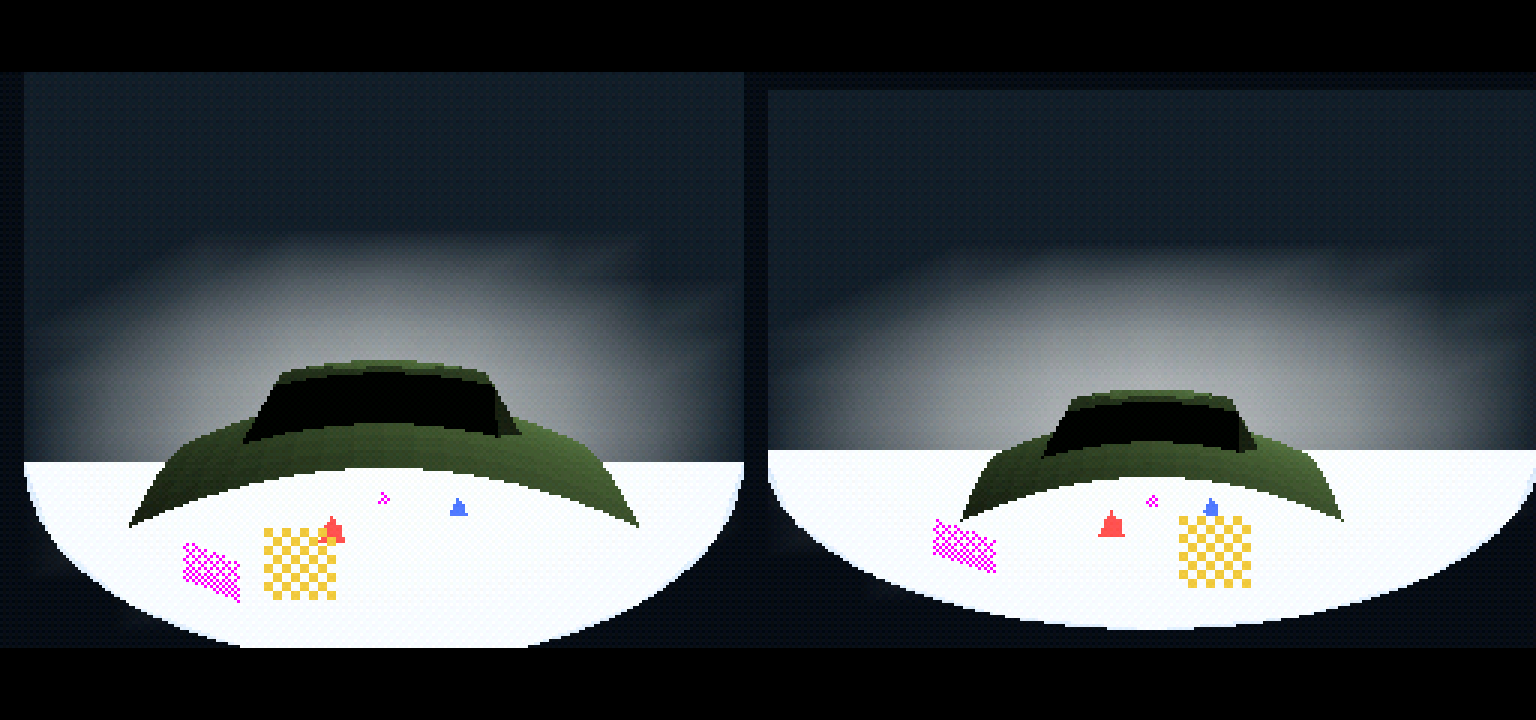
Duo: the committed golden frame 512 × 240 displayed · shown at 3×
The full two-player picture: two independent 256×192 views of the same world, centred by black border bands. Visible: the 360° sky, a heightfield island deformed by a terrain program, a crack-ring scar stamped into the ground's persistent damage record, a marker sigil per view, and additively-blended particles.
The two cameras are set to different positions on purpose, which is why the island sits closer on the left. Both views are the same size and the same field of view; only the eye height and the distance differ. If the views were ever wired to one camera by mistake, or one view's state leaked into the other, two matching pictures would look entirely correct and the fault would pass unnoticed. Making them disagree is what makes that failure visible. In the game itself the rule is the opposite: both players get the same camera height and the same distance, because a higher viewpoint is a competitive advantage and not a style choice.
This frame earned its place by catching a real bug. The renderer and the hardware design had implemented two incompatible readings of how a split-screen frame is stored in memory; read it the wrong way and you get a garbled, dark image. The stored layout was ratified, both sides now agree, and this exact frame is pinned in the test suite by checksum. The two hashes below are the committed constants, and this render reproduces both.
mode=DUO 512x240 displayed (2 x 256x192 views + 48 black border lines) status=0 commands=14 resource_misses=0 canvas_crc32c=0x47893F4C displayed_crc32c=0xC3ED350F audio_events=2 terrain_velocity_samples=81
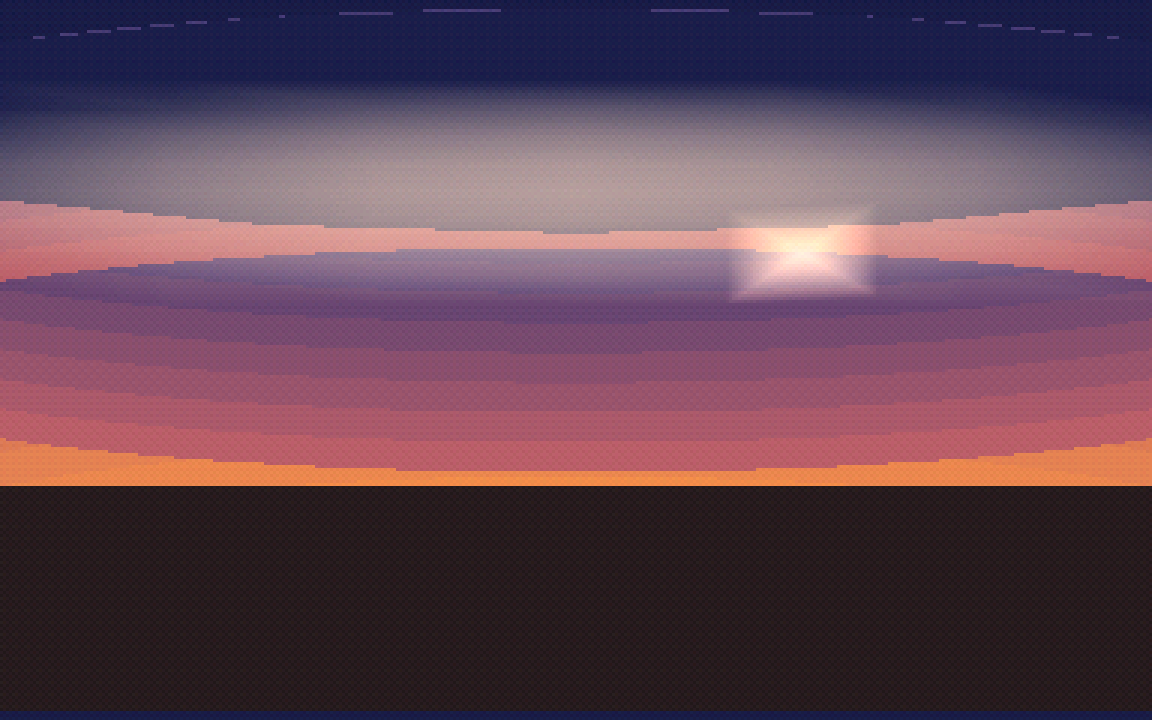
Sky: the dome, and a real sun 384 × 240 (Z60) · shown at 3×
A dusk sky rendered on its own. The backdrop is a real 360° cylinder of 48 gradient columns, closed by a zenith cap above and an under-plane below, with a scrolling cloud sheet: 1,844 triangles, rendered like any other geometry, projected with true perspective. One elevation ramp drives every layer, and the layer joins are required to be colour-continuous, so no seam survives from horizon to zenith. Both of those are recent fixes: the sky used to project linearly (painting both sides of the cylinder onto the screen) and each layer carried its own colour, which drew the cap and ground rims as hard elliptical outlines.
The sun is new too. It is a star from the console's 12-class star system: a distance-washed white core, a corona read through the same 64-entry colour ramp as the disc, and a lens ghost chain, drawn by the celestial compositor rather than the old flat additive quad.
mode=Z60 384x240 single view, DrawSky only status=0 canvas_crc32c=0xB8968C1F sky primitives emitted=1840 (1536 drum bands + 48 zenith cap + 128 under-plane + 128 cloud + 4 sun) tick=1234 (cloud scroll) drum_yaw=0x1800 rot_proj: scale 18, pitch cos 17 / sin 4 (rotation-only, validated)
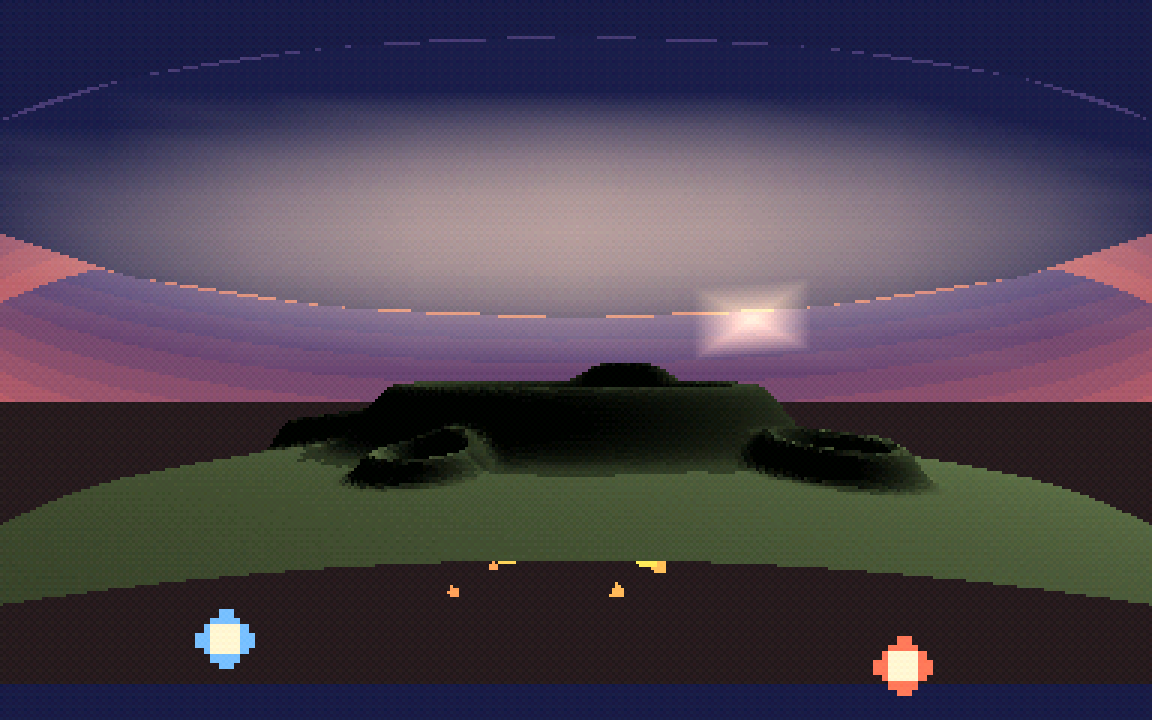
Island: deformation and damage 384 × 240 (Z60) · shown at 3×
The terrain story in one frame. The island is a 161 × 161 grid of
height values: 51,200 triangles at 15 cm spacing. Over it run six applications of
one compiled terrain program, crater_ring, each with its own centre, radius
and strength. Those are the overlapping crater rims, computed live rather than sculpted
by an artist. Two more commands stamp crack rings into the island's persistent damage
sheet, which darkens the shading where the ground was hurt.
The scar outlives the frame that made it: the damage sheet persists, so a later frame with no stamp command renders identically.
mode=Z60 384x240 single view status=0 commands=17 resource_misses=0 canvas_crc32c=0x817A8155 patch=161x161 heightfield, +-12 m envelope, 8 m peak, 0.150 m grid spacing (sub-metre) geometry: 25600 cells -> 51200 triangles; terrain decided 18092 of 92160 pixels (coverage after overdraw, not fragment invocations) TerrainField program=crater_ring hash=0x484ADD8D (28 instrs), 6 applications stacked main crater: centre (0,0) r_in 3 m r_out 7 m amplitude 4.0 m; tick 19 of 100 -> phase 0.190 SurfaceStamp: 2 crack rings, tag 1 - outer radius 7 m width 4 m strength 0xC000, inner radius 2.5 m width 1 m strength 0x9000 terrain_velocity_samples=32114

crater_ring: a terrain program, visualised 256 × 256 data map · shown at 3×
This one is a data visualisation, not a scene. It is
the raw height output of the crater_ring program, sampled on a grid and
false-coloured from dark (zero) to bright (maximum). No camera, no lighting, just the
number the program returns at each point of the ground.
Terrain programs are compiled bytecode, not shaders: a compiler emits a small program image, the image is checksummed, and exactly one interpreter evaluates it, the same interpreter the renderer calls when it deforms terrain. The interpreter exists twice, in C++ and TypeScript, and tests hold the two byte-identical.
crater_ring earth field program, hash=0x484ADD8D, 28 instructions grid=256x256 over x,z in [-10 m, +10 m]; height output lane only params: p0/p1 centre (0,0), p2 r_in 3 m, p3 r_out 7 m, p4 amplitude 4 m phase=0.190 (age 19 of 100 ticks) height range: 0.0000 m .. 2.3227 m (fx16 raw 0 .. 152220) saturating evaluations: 0 of 65536
In motion: the deformation reel
Deformation is the one thing a still cannot show. These loops are the reference renderer's actual frame sequences, encoded with each subject's own exact colour palette and verified by decoding the file back and comparing every frame byte-for-byte against the source. What the loop shows is what the renderer drew: no re-compression, no dithering, no interpolation.
Development-state renders. Renderer changes re-captured every loop on this page: the sky now projects with true perspective under a colour-continuity law (the old sky read as flat ovals); islands use the dual-heightfield format with a modelled top and bottom surface, so holes can be punched clean through; and island surfaces are now textured per polygon over a deep keel. All pinned checksums were re-derived and re-committed with those changes, deliberately and in writing. The diary section below preserves what the islands looked like before the keel: flat-shaded colour on a 22 m sheet.
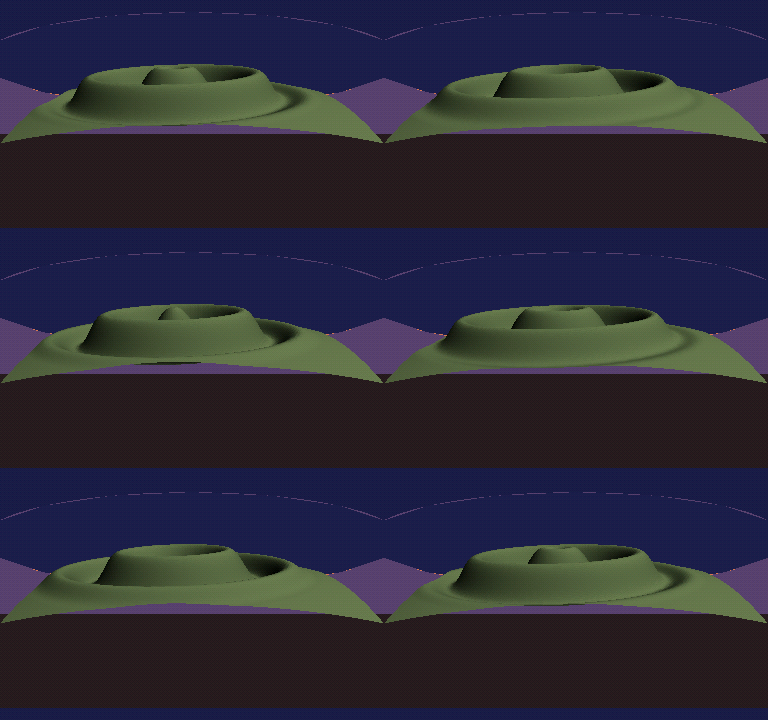
Membrane: a travelling wave 384 × 240 (Z60) · 64-frame loop · shown at 3×
The signature behaviour: ground acting as a rubbery
membrane, not dirt with a hole punched in it. A terrain program,
wave_pool, expresses a travelling radial wave using only the instruction
set the hardware will freeze. The wave is exactly periodic by construction, so the loop
closes without a seam. Every frame is a full evaluation of the program over the whole
island, then the ordinary render. Nothing here is a canned animation.
subject=terrain-wave mode=Z60 384x240 single view, reference oracle (zref::render) frames=64 step=8 ticks (frame f: tick = f*step) programs: wave_pool hash=0x8BDCEB63 (27 instrs), impact_wave hash=0x82F5F4E4 (30 instrs) field_apps=1 stamps=0 debris=0 shake_frames=0 palette=143 unique colours (palette-exact by construction, <=256 enforced) travelling radial wave, n=2 whole cycles per loop: frame 63 steps straight back to frame 0 sequence_crc32c=0x31159F59 gif: 64 frames at 20 fps, 486,705 B, palette 143 of 256, paletteuse=dither=none (no palettegen) encode verified: decoded GIF matches every source frame byte-for-byte (CRC-32C cross-checked) inter-frame change: median 7.9% of pixels, max 8.9%, min 7.1%
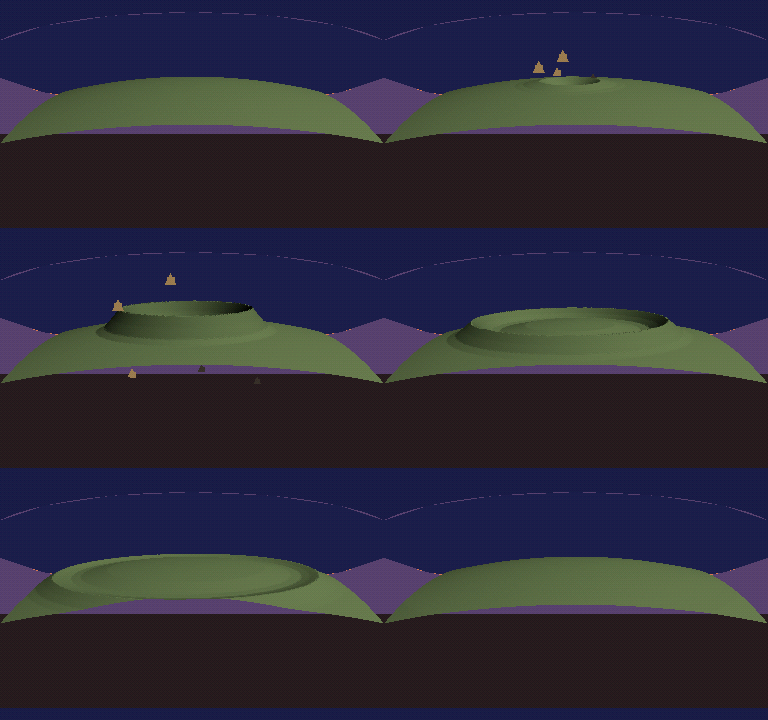
Impact: strike, wave, rebound, settle 384 × 240 (Z60) · 80-frame loop · shown at 3×
Sacrifice's most famous moment, mechanised. One program,
impact_wave, drives the whole event: the strike dents the ground, a ring
wave expands outward, the centre rebounds through a damped wobble, and everything
returns exactly to rest. Ballistic debris and a decaying screen shake ride along. The
loop starts and ends at rest, so the restart reads as the next strike landing.
subject=terrain-impact mode=Z60 384x240 single view, reference oracle (zref::render) frames=80 step=8 ticks (frame f: tick = f*step) programs: wave_pool hash=0x8BDCEB63 (27 instrs), impact_wave hash=0x82F5F4E4 (30 instrs) field_apps=1 stamps=0 debris=8 shake_frames=10 palette=150 unique colours (palette-exact by construction, <=256 enforced) strike -> expanding annular wave -> centre rebound -> settle; debris + screen shake (erupt-style garnish); starts and ends at rest sequence_crc32c=0x12427B5F gif: 80 frames at 20 fps, 311,413 B, palette 150 of 256, paletteuse=dither=none (no palettegen) encode verified: decoded GIF matches every source frame byte-for-byte (CRC-32C cross-checked) inter-frame change: median 4.3% of pixels, max 11.0%, min 1.1%
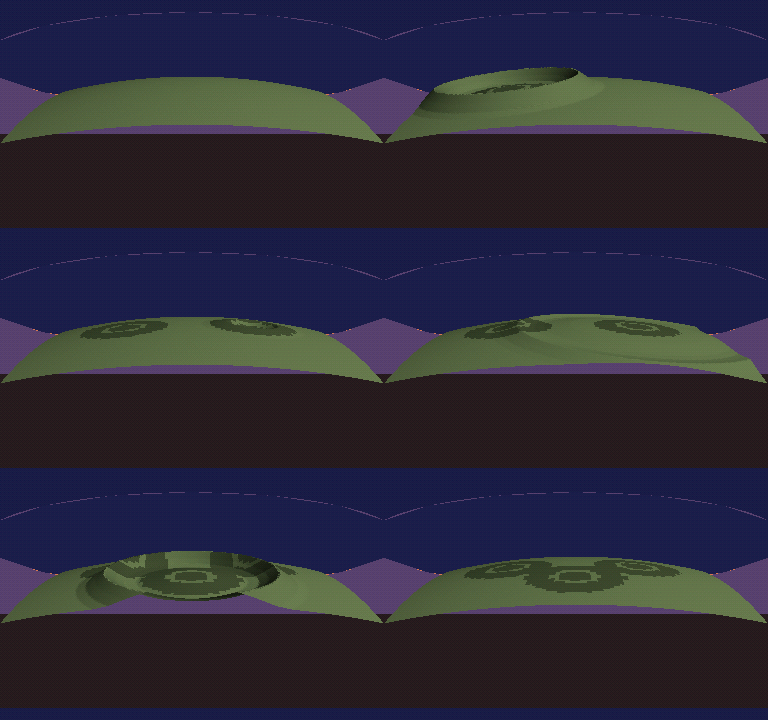
Scars: damage that accrues 384 × 240 (Z60) · 96-frame sequence · shown at 3×
Three strikes land in sequence: the same compiled
impact_wave program applied three times with different centres and start
times, stacking in command order. As each wave settles, a crack ring is stamped into the
island's persistent damage sheet, and the darkened scars stay. The
sequence holds at the end so the accumulated scarring reads.
subject=terrain-scars mode=Z60 384x240 single view, reference oracle (zref::render) frames=96 step=8 ticks (frame f: tick = f*step) programs: wave_pool hash=0x8BDCEB63 (27 instrs), impact_wave hash=0x82F5F4E4 (30 instrs) field_apps=3 stamps=6 debris=0 shake_frames=0 palette=144 unique colours (palette-exact by construction, <=256 enforced) three strikes in sequence; surface-sheet scars persist and accrue (the loop restart is the sequence replaying) sequence_crc32c=0x3C186D25 gif: 96 frames at 20 fps, 314,462 B, palette 144 of 256, paletteuse=dither=none (no palettegen) encode verified: decoded GIF matches every source frame byte-for-byte (CRC-32C cross-checked) inter-frame change: median 4.9% of pixels, max 7.4%, min 0.0%
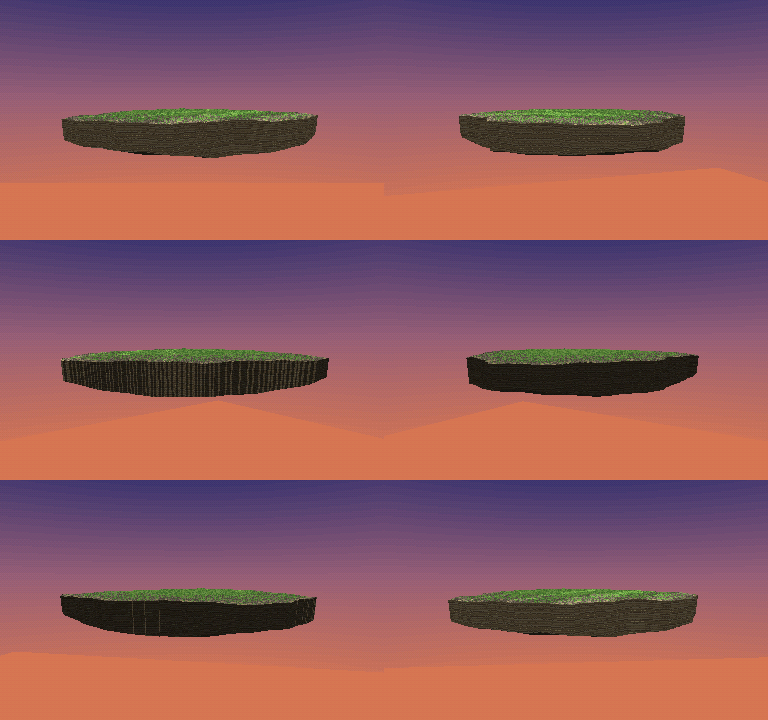
Orbit: solid rock, not paper 384 × 240 (Z60) · 64-frame sequence · one exact 360 degree turn · 320 m island · shown at 3×
Every polygon on this island is textured, and the island is deep. The top samples a 64 by 64 CLUT8 tile per two-metre cell; where grass meets coastal rock, a stable world-space pattern picks between the two candidates one texel at a time, so the border is a dither and never a blend. The rim walls sample a strata tile whose bands follow the modelled bottom, and the mirrored-repeat fold makes the bands stack like geology for free.
The keel is the default now: an island this size drops 75 metres at the heart and 30 at the rim, measured from its own radius with the donor engine's fixed 50 metre curtain as the floor. The camera sweeps a full circle in 64 steps and the world-fixed sun crosses the frame because the sky rotates with it. Dusk light shows under the rim.
subject=terrain-orbit mode=Z60 384x240 single view, reference oracle (zref::render) frames=64 step=8 ticks (frame f: tick = f*step) programs: wave_pool hash=0x8BDCEB63 (27 instrs), impact_wave hash=0x82F5F4E4 (30 instrs) field_apps=0 stamps=0 debris=0 shake_frames=0 palette=166 unique colours (palette-exact by construction, <=256 enforced) one exact 360-degree orbit per loop: textured top (per-texel Mosaic dither of grass/rock/sand), strata-banded rim walls, 75 m modelled keel (3.7 default: R/2 over the 50 m donor floor), dusk sky below the rim, sun sweeping with the world-fixed sky sequence_crc32c=0xAB956041 gif: 64 frames at 20 fps, 495,569 B, palette 166 of 256, paletteuse=dither=none (no palettegen) encode verified: decoded GIF matches every source frame byte-for-byte (CRC-32C cross-checked) inter-frame change: median 10.1% of pixels, max 11.6%, min 9.1%
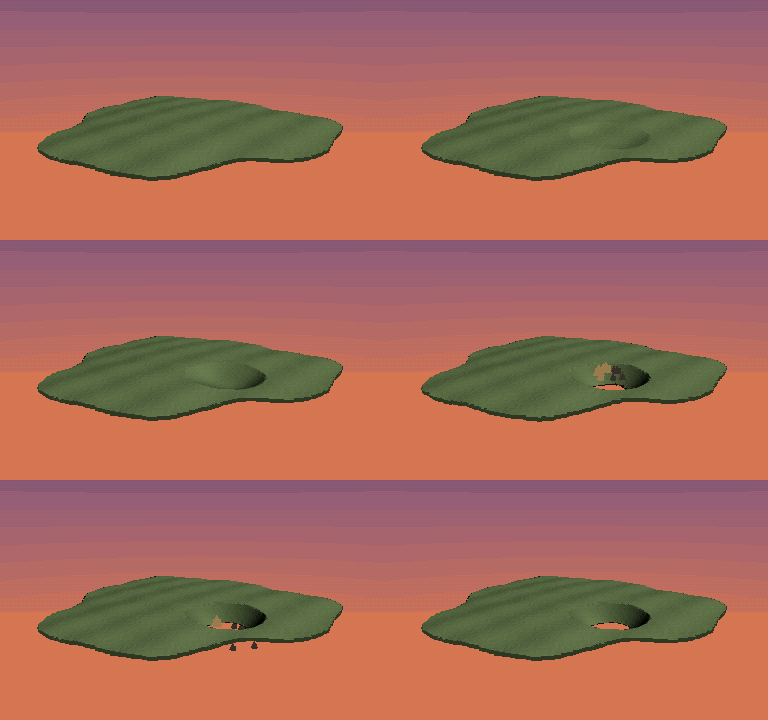
Breach: a hole through a world 384 × 240 (Z60) · 64-frame sequence · 84 m dig through a 75 m keel · shown at 3×
The same island as above, put under the spade. An 84 metre bake ramp digs into ground that is 65 metres thick right there; cells give way when their four corners all meet the modelled bottom, and the new rim clothes itself in strata down to the real underside. Because neighbouring cells share corners, the ground sags toward the hole before it drops; the crumble comes from the geometry itself, not from an animation.
Where Sacrifice dressed every hole with a fixed fake curtain wall, these walls end at the island's actual underside, and the hole runs through enough rock that debris falls for a long time before it leaves the world. Every breach is a discrete, exactly-reproducible event.
subject=terrain-breach mode=Z60 384x240 single view, reference oracle (zref::render) frames=64 step=8 ticks (frame f: tick = f*step) programs: wave_pool hash=0x8BDCEB63 (27 instrs), impact_wave hash=0x82F5F4E4 (30 instrs) field_apps=0 stamps=0 debris=8 shake_frames=10 palette=161 unique colours (palette-exact by construction, <=256 enforced) 320 m textured dual-heightfield island (2.0 m pitch, 3.7 deep-keel default: 75 m heart / 30 m rim); 36-step bake ramp digs an 84 m pit THROUGH the keel; cells breach corner-coupled; strata rim walls run to the MODELLED bottom; sky visible through the island; debris falls through the world sequence_crc32c=0x54B0C505 gif: 64 frames at 20 fps, 182,257 B, palette 161 of 256, paletteuse=dither=none (no palettegen) encode verified: decoded GIF matches every source frame byte-for-byte (CRC-32C cross-checked) inter-frame change: median 0.9% of pixels, max 20.1%, min 0.0%
Creatures: rings, bones and a ladder down to glints
A creature is a list of ring-cylinders stitched into meshlets and hung on at most 32 bones. Animation is 8 bytes per bone per frame, packed quaternions decoded on demand into a shared pose cache, and nothing ever blends: one clip hard-cuts to the next, exactly as the donor shipped it. The body tilts with the ground under it because two height samples per tick say it should. When the camera retreats, the whole animal collapses through a ladder of representations, ending as a two-pixel glint.
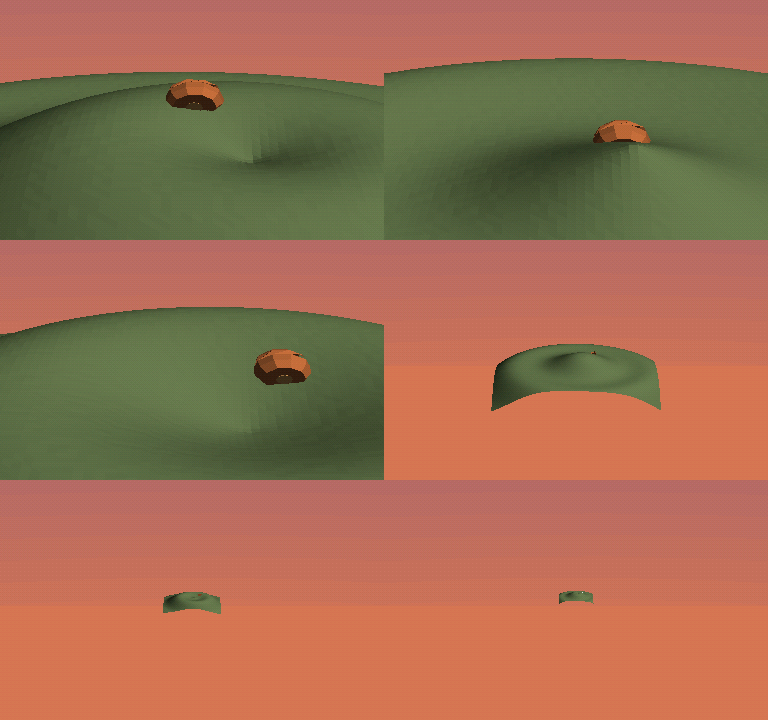
Wave walk: tilt through the crest, fade to a glint 384 × 240 (Z60) · 96-frame loop · shown at 3×
A watchdog quadruped has six bones and six rigid ring parts: a long rust torso, a pale head, and four separately bound legs. It strides along its authored forward axis while a travelling wave crosses under it. Two ground-height samples per tick, one ahead and one to the side, give the slope; the body tilts to follow it, rate-limited so it leans rather than snaps. From frame 48 the camera retreats from 8 m to 300 m and the ladder takes over: full mesh, then a decimated micro-mesh, then a splat quad, then a glint. Each step down is gated by projected screen error with a ten percent hysteresis band and a fifteen-tick hold, so the rungs do not flicker at the boundary.
subject=creature-wave-walk mode=Z60 384x240 single view, reference oracle (zref::render) frames=96 step=1 ticks (frame f: tick = f*step) programs: wave_pool hash=0x8BDCEB63 (27 instrs), impact_wave hash=0x82F5F4E4 (30 instrs) field_apps=1 stamps=0 debris=0 shake_frames=0 palette=229 unique colours (palette-exact by construction, <=256 enforced) watchdog quadruped (6 bones, 6 rigid ring parts: long torso, pale head, 4 separate legs) walks along its authored +X axis at 0.022 m/frame; the 16-key stride is held on the sim clock, so one full gait cycle spans 32 frames and lays down 0.70 m, about one body length per cycle; a 0.5 m-amplitude wave crosses under it and two column_query taps per tick tilt it through the crest; frames 48+ pull the camera back 8 m -> 300 m and the LOD ladder walks it down mesh -> micro-mesh -> splat -> glint (screen-space error, 10% hysteresis, 15-tick hold) sequence_crc32c=0x6BEECDE5 gif: 96 frames at 20 fps, 1,329,653 B, palette 229 of 256, paletteuse=dither=none (no palettegen) encode verified: decoded GIF matches every source frame byte-for-byte (CRC-32C cross-checked) inter-frame change: median 39.4% of pixels, max 62.2%, min 0.2%
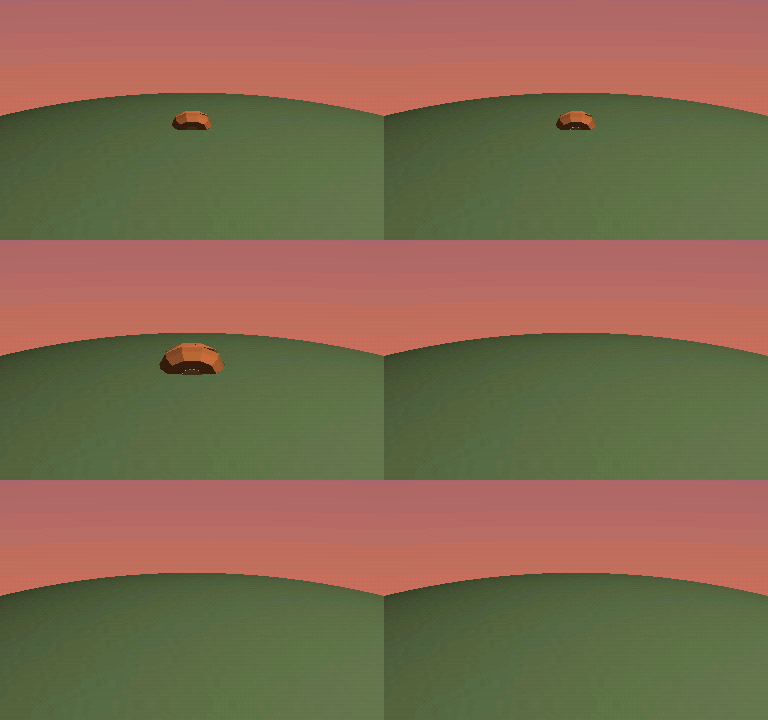
Bulk pop: one scalar, then gibs 384 × 240 (Z60) · 72-frame loop · shown at 3×
The same six-part watchdog idles on a hilltop, breathing. Bulk inflation is a single scale factor at the root, smoothed toward a rising target. Crossing the species threshold of 2.2 removes the mesh outright and releases eighteen independently translated and rotating chunks sampled deterministically from donor geometry. Their integer ballistics spread the pieces for multiple frames before gravity and damped ground bounces bring them down; each chunk remains depth-tested geometry rather than a screen-space square.
subject=creature-bulk-pop mode=Z60 384x240 single view, reference oracle (zref::render) frames=72 step=8 ticks (frame f: tick = f*step) programs: wave_pool hash=0x8BDCEB63 (27 instrs), impact_wave hash=0x82F5F4E4 (30 instrs) field_apps=0 stamps=0 debris=0 shake_frames=0 palette=155 unique colours (palette-exact by construction, <=256 enforced) six-part watchdog idles (32-key breathing clip) while bulk inflates the root scale 1.0 -> 2.3 (exponential smoothing, one scalar); crossing the 2.2 pop threshold removes the mesh and releases 18 detached rotating chunks, deterministically sampled from donor gibs, with integer ballistics, gravity, and damped ground bounce sequence_crc32c=0x327DBB91 detached_pieces=18 spawn_frame=39 visible_early_frames=12 initial_span_raw=133018 max_span_raw=980452 gif: 72 frames at 20 fps, 104,203 B, palette 155 of 256, paletteuse=dither=none (no palettegen) encode verified: decoded GIF matches every source frame byte-for-byte (CRC-32C cross-checked) inter-frame change: median 1.6% of pixels, max 9.5%, min 0.0%
The sky and the stars
The sky is geometry and the stars are palettes. Star colour never exists at draw time: the disc and its corona are drawn as intensity through a 64-entry colour ramp the CPU rebuilds each frame, which is how Noctis IV coloured its entire universe, and it is native territory for a palette console. Lens flares are frozen-table sprite splats into a quarter-resolution glow plane; there is no shader anywhere, because the machine refuses to have any.
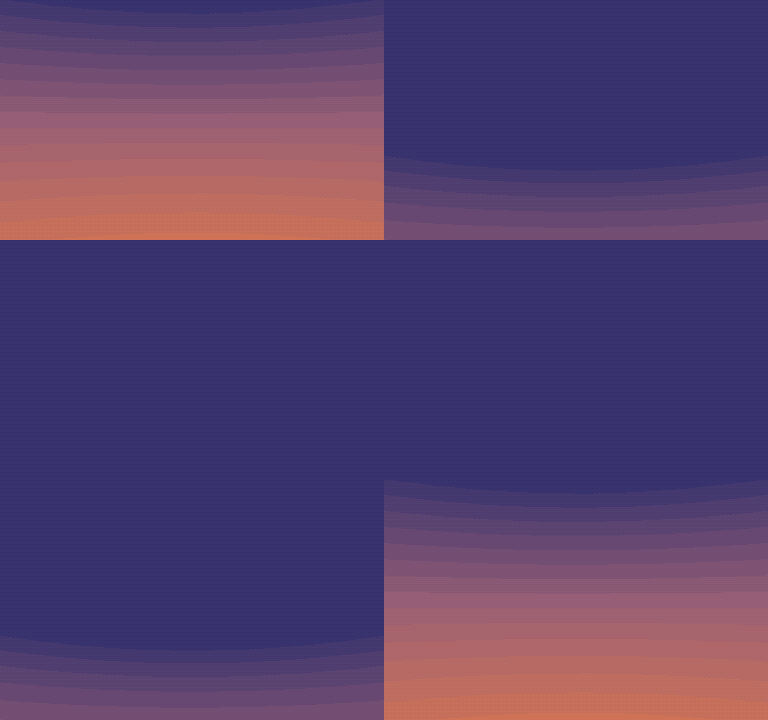
Sky sweep: horizon to zenith 384 × 240 (Z60) · 64-frame loop · shown at 3×
The camera pitches from just above the horizon to straight up and back. The sky is five separate pieces of geometry: an under-plane, two drum bands, a zenith cap. The point of the loop is what you cannot see: the joins between them cross the whole frame during the sweep and never show, because a ratified continuity law requires the colour at every join to match exactly. Before that law existed, the cap and ground rims rendered as hard elliptical outlines; the project owner's report ("ovals, not sky") is what forced it.
subject=sky-sweep mode=Z60 384x240 single view, reference oracle (zref::render) frames=64 step=8 ticks (frame f: tick = f*step) programs: wave_pool hash=0x8BDCEB63 (27 instrs), impact_wave hash=0x82F5F4E4 (30 instrs) field_apps=0 stamps=0 debris=0 shake_frames=0 palette=67 unique colours (palette-exact by construction, <=256 enforced) camera pitch sweep, horizon to zenith and back; one elevation ramp drives under-plane, both drum bands and the zenith cap, so the layer joins cross the frame without a visible edge sequence_crc32c=0x99A3E1A0 gif: 64 frames at 20 fps, 235,544 B, palette 67 of 256, paletteuse=dither=none (no palettegen) encode verified: decoded GIF matches every source frame byte-for-byte (CRC-32C cross-checked) inter-frame change: median 19.3% of pixels, max 88.4%, min 0.0%
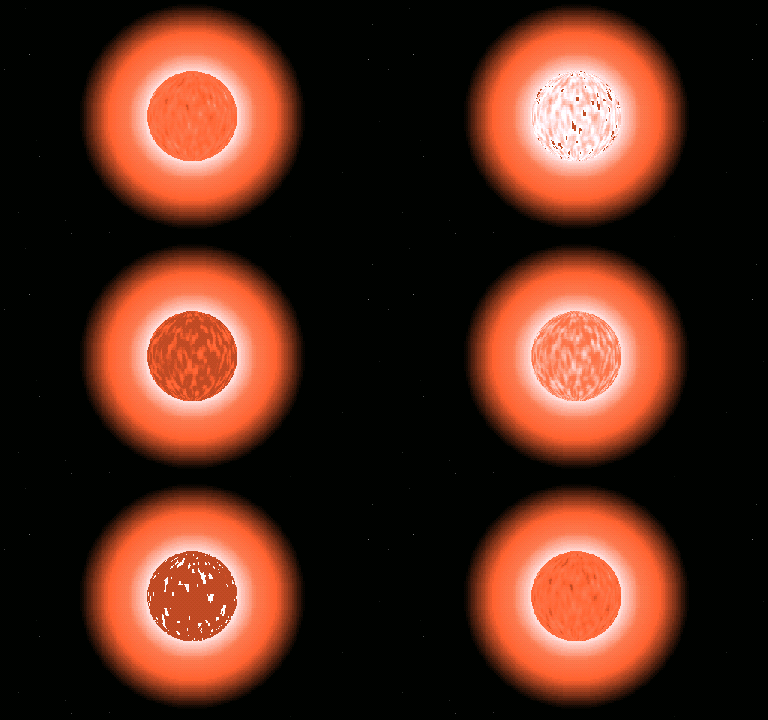
Red giant: the boiling disc 384 × 240 (Z60) · 63-frame loop · shown at 3×
An S03 red giant from 1.5 radii, one of twelve star classes carried over from Noctis IV with their exact colour tables. The granulation churns every frame, and no pixel of the texture is ever rewritten: the surface is a static noise texture indexed through a 64-entry ramp, and the animation is the ramp rotating one step at a time. 63 frames is exactly one full revolution of the palette, so the loop closes on the period of the colour table itself. The corona reads through the same ramp, so it is automatically the star's own colour fading to black. The dots behind it are the procedural starfield: one star per 100,000-unit sector of space, existence and position a pure integer hash held bit-exact against the original game's arithmetic.
subject=star-boil mode=Z60 384x240 single view, reference oracle (zref::render) frames=63 step=6 ticks (frame f: tick = f*step) programs: wave_pool hash=0x8BDCEB63 (27 instrs), impact_wave hash=0x82F5F4E4 (30 instrs) field_apps=0 stamps=0 debris=0 shake_frames=0 palette=170 unique colours (palette-exact by construction, <=256 enforced) S03 red giant at 1.5 radii; granulation is a 63-entry palette rotation, zero texels rewritten per frame; ENLARGED to 80 px disc radius for legibility (was invisible at gallery scale) sequence_crc32c=0xDF05E21E gif: 63 frames at 20 fps, 571,043 B, palette 170 of 256, paletteuse=dither=none (no palettegen) encode verified: decoded GIF matches every source frame byte-for-byte (CRC-32C cross-checked) inter-frame change: median 17.2% of pixels, max 19.1%, min 0.8%
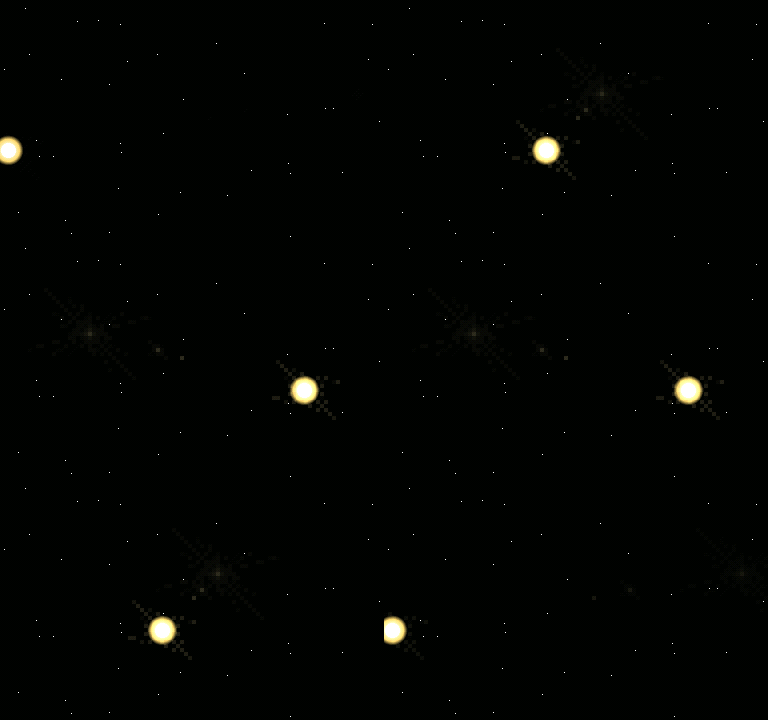
Lens flare: the ghost chain 384 × 240 (Z60) · 64-frame loop · shown at 3×
A yellow star at forty radii sweeps the frame. The lens chain rides it: a twelve-spoke burst at the light, and three ghost copies mirrored through the screen centre at fixed fractions of the lens axis, each a shrunken starburst, exactly as the original renders them. The spoke lengths zig-zag through a frozen eight-entry table, so the star shape is jagged but perfectly stable frame to frame. Everything is additive sprite splats into a quarter-resolution glow buffer, tinted by the star's class colour, bounded at 16,384 texels a frame. As the light nears the frame edge the flare dims over the last 16 pixels instead of cutting, which removes the one hard pop the original had.
subject=noctis-flare mode=Z60 384x240 single view, reference oracle (zref::render) frames=64 step=8 ticks (frame f: tick = f*step) programs: wave_pool hash=0x8BDCEB63 (27 instrs), impact_wave hash=0x82F5F4E4 (30 instrs) field_apps=0 stamps=0 debris=0 shake_frames=0 palette=240 unique colours (palette-exact by construction, <=256 enforced) S00 at 40 radii; burst and three lens ghosts over a graded, connected motion smear rebuilt with subtract-8 decay and asymmetric diffusion; the flare dims over the outer 16 px instead of cutting sequence_crc32c=0x347B72F6 gif: 64 frames at 20 fps, 185,341 B, palette 240 of 256, paletteuse=dither=none (no palettegen) encode verified: decoded GIF matches every source frame byte-for-byte (CRC-32C cross-checked) inter-frame change: median 4.3% of pixels, max 4.6%, min 1.1%
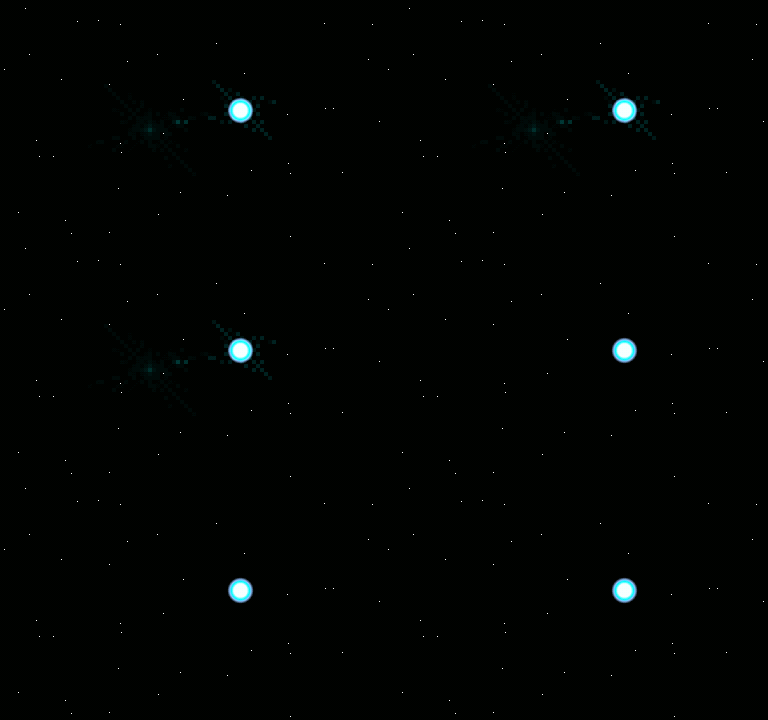
Pulsar: a strobe by law 384 × 240 (Z60) · 64-frame loop · shown at 3×
Class S11: a 250-unit core, the smallest object in the star table, with the airless-corona bake (hard bright core, steep skirt). Its flare is gated by the duty law carried over from the original: the burst is on only while the spin phase is in the first quarter turn. One comparator makes the cheapest exotic object in the catalogue. The blink rate comes from the star's own spin draw, 715 angle units per tick.
subject=pulsar mode=Z60 384x240 single view, reference oracle (zref::render) frames=64 step=8 ticks (frame f: tick = f*step) programs: wave_pool hash=0x8BDCEB63 (27 instrs), impact_wave hash=0x82F5F4E4 (30 instrs) field_apps=0 stamps=0 debris=0 shake_frames=0 palette=194 unique colours (palette-exact by construction, <=256 enforced) S11 pulsar at 40 radii; the flare strobes on the S2 duty law (spin_phase < 0x4000, one quarter of each rotation); ENLARGED to 28 px disc radius for legibility (was 4 px, read as 'a dot phasing') sequence_crc32c=0x69F44CA3 gif: 64 frames at 20 fps, 17,943 B, palette 194 of 256, paletteuse=dither=none (no palettegen) encode verified: decoded GIF matches every source frame byte-for-byte (CRC-32C cross-checked) inter-frame change: median 0.0% of pixels, max 0.2%, min 0.0%
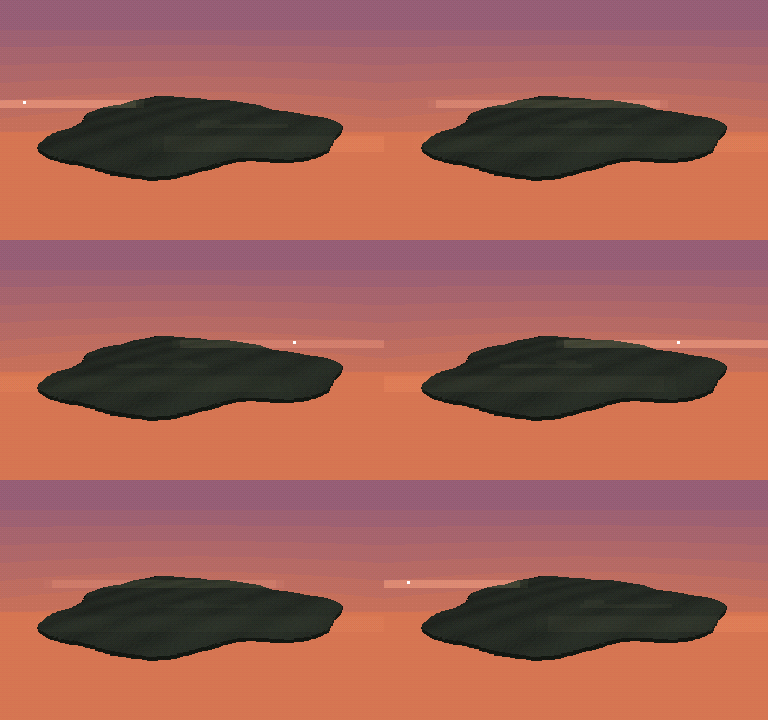
Occlusion: the fade the original lacked 384 × 240 (Z60) · 64-frame loop · shown at 3×
A distant sun crosses behind the island at dusk. At six hundred radii the star is a two-pixel glint and its flare collapses to the signature horizontal streak, which falls out of the distance law for free. Visibility is one byte: a probe latches the effect-tag at the sun's screen position, and if the tag was not written by a glowing source, the sun is hidden. Noctis tested the same single pixel and its flare popped on and off in one frame; here a four-bit counter walks the flare's strength one step per frame, so the streak takes fifteen frames to melt away behind the island and fifteen to return. The probe reads a latched byte, never the framebuffer.
subject=flare-occlusion mode=Z60 384x240 single view, reference oracle (zref::render) frames=64 step=8 ticks (frame f: tick = f*step) programs: wave_pool hash=0x8BDCEB63 (27 instrs), impact_wave hash=0x82F5F4E4 (30 instrs) field_apps=0 stamps=0 debris=0 shake_frames=0 palette=110 unique colours (palette-exact by construction, <=256 enforced) S00 sun at 30 radii crossing behind the island; the effect-tag probe gates the flare and a 4-bit counter fades it 15 frames each way; halo_atmo variant (atmosphere = one bake parameter) sequence_crc32c=0x47C98B90 gif: 64 frames at 20 fps, 103,111 B, palette 110 of 256, paletteuse=dither=none (no palettegen) encode verified: decoded GIF matches every source frame byte-for-byte (CRC-32C cross-checked) inter-frame change: median 1.7% of pixels, max 5.0%, min 0.0%
Suns, seen from the ground
Ten worlds. On each one the sky and the sun are the same thing: a single brightness field with one colour table laid over it, so a world's whole identity is a handful of numbers rather than a sky asset and a star asset that have to be kept in agreement. The sun is drawn straight into that brightness field and allowed to overflow, which is why it has no edge and no colour of its own. It takes the colour the sky reaches at its brightest.
That is also why these fit. The whole sky, however enormous the sun, can only ever select the colours in one table. The largest sun in this set produces the loop with the fewest colours in it.
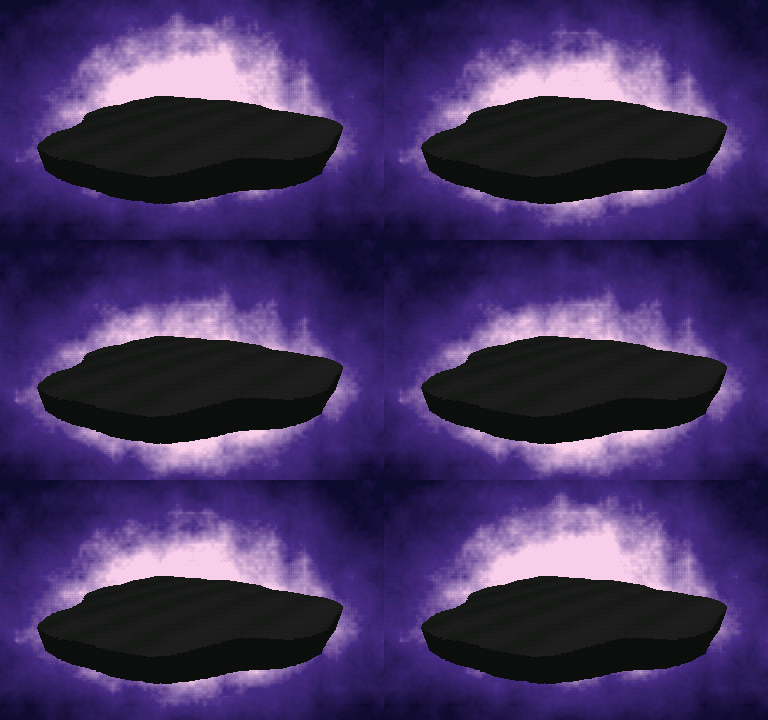
A thick atmosphere 384 × 240 (Z60) · 48-frame loop · shown at 3×
The sun has no disc. There is nothing to see but light spread through air, and it spreads further as the sun drops because the sky it is adding into is already brightest at the horizon.
subject=planet-sun-violet mode=Z60 384x240 single view, reference oracle (zref::render) frames=48 step=8 ticks (frame f: tick = f*step) programs: wave_pool hash=0x8BDCEB63 (27 instrs), impact_wave hash=0x82F5F4E4 (30 instrs) field_apps=0 stamps=0 debris=0 shake_frames=0 palette=130 unique colours (palette-exact by construction, <=256 enforced) a thick-atmosphere world: the sun has NO disc at all, only a bloom that spreads as it sets. Sky and sun are one six-bit intensity plane coloured through one ramp, so the sun's colour IS the sky's peak entry and the whole frame costs 64 colours however large the bloom grows sequence_crc32c=0x7DFDD03C gif: 48 frames at 20 fps, 1,150,722 B, palette 130 of 256, paletteuse=dither=none (no palettegen) encode verified: decoded GIF matches every source frame byte-for-byte (CRC-32C cross-checked) inter-frame change: median 26.0% of pixels, max 32.1%, min 0.0%
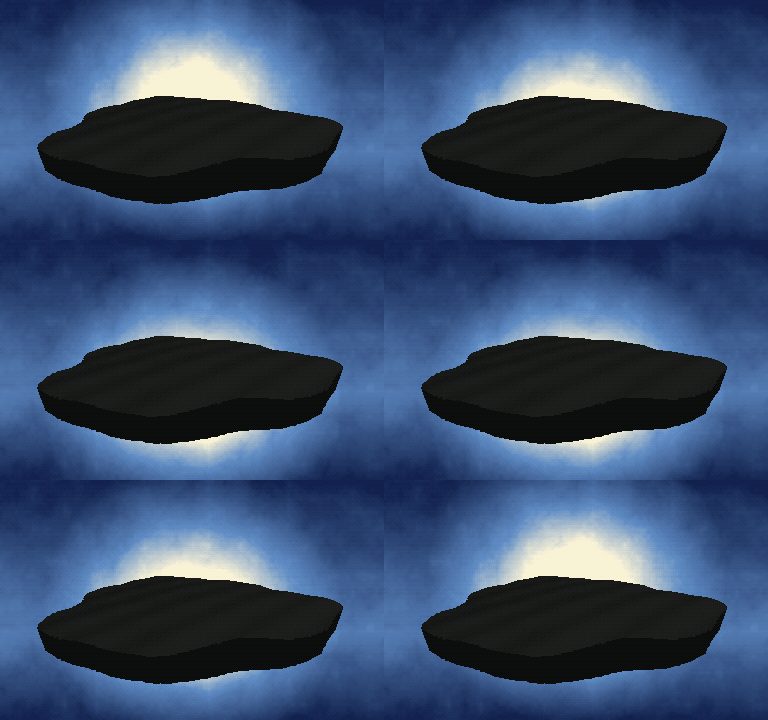
Thinner air 384 × 240 (Z60) · 48-frame loop · shown at 3×
Less air, so less mottling and a tighter bloom. The sun stays close to white here only because this sky's brightest colour is close to white.
subject=planet-sun-terran mode=Z60 384x240 single view, reference oracle (zref::render) frames=48 step=8 ticks (frame f: tick = f*step) programs: wave_pool hash=0x8BDCEB63 (27 instrs), impact_wave hash=0x82F5F4E4 (30 instrs) field_apps=0 stamps=0 debris=0 shake_frames=0 palette=151 unique colours (palette-exact by construction, <=256 enforced) thinner air over a blue world: less mottling, a tighter bloom, and a sun that stays closer to white because the ramp's peak does sequence_crc32c=0x503D3FB9 gif: 48 frames at 20 fps, 965,080 B, palette 151 of 256, paletteuse=dither=none (no palettegen) encode verified: decoded GIF matches every source frame byte-for-byte (CRC-32C cross-checked) inter-frame change: median 28.1% of pixels, max 33.4%, min 0.0%
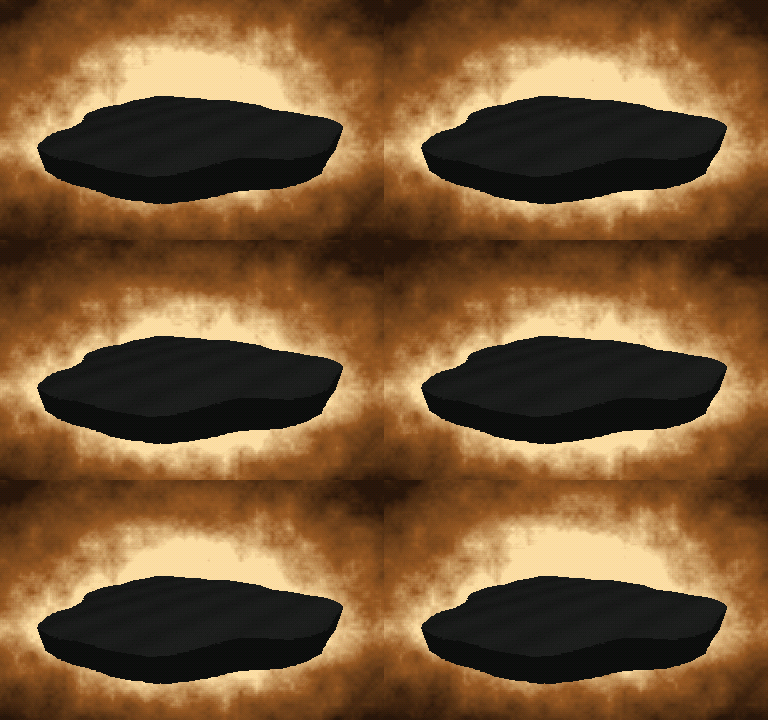
Dust 384 × 240 (Z60) · 48-frame loop · shown at 3×
On a dusty world the air itself is the colour, so the sun is hard to pick out from the sky it sits in. That is the effect working, not the renderer failing to draw a sun.
subject=planet-sun-dust mode=Z60 384x240 single view, reference oracle (zref::render) frames=48 step=8 ticks (frame f: tick = f*step) programs: wave_pool hash=0x8BDCEB63 (27 instrs), impact_wave hash=0x82F5F4E4 (30 instrs) field_apps=0 stamps=0 debris=0 shake_frames=0 palette=137 unique colours (palette-exact by construction, <=256 enforced) a dust world where the atmosphere is the colour: the bloom is barely separable from the sky it sits in, which is the point rather than a failure to render it sequence_crc32c=0x6FFC26E5 gif: 48 frames at 20 fps, 1,311,472 B, palette 137 of 256, paletteuse=dither=none (no palettegen) encode verified: decoded GIF matches every source frame byte-for-byte (CRC-32C cross-checked) inter-frame change: median 26.9% of pixels, max 34.1%, min 0.0%
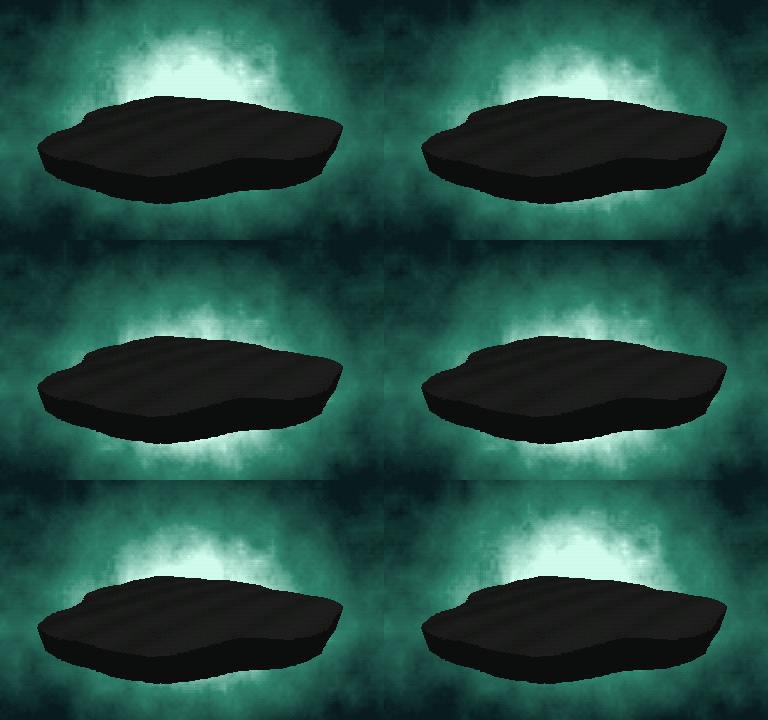
Methane 384 × 240 (Z60) · 48-frame loop · shown at 3×
The colour ramp carries three control points rather than two, so a world's identity can live in the middle of the range while the brightest end stays near white.
subject=planet-sun-methane mode=Z60 384x240 single view, reference oracle (zref::render) frames=48 step=8 ticks (frame f: tick = f*step) programs: wave_pool hash=0x8BDCEB63 (27 instrs), impact_wave hash=0x82F5F4E4 (30 instrs) field_apps=0 stamps=0 debris=0 shake_frames=0 palette=149 unique colours (palette-exact by construction, <=256 enforced) a methane sky. The ramp carries three control points, not two, so the world's identity lives in the mid body while the peak stays near white sequence_crc32c=0xFB3E3581 gif: 48 frames at 20 fps, 1,188,847 B, palette 149 of 256, paletteuse=dither=none (no palettegen) encode verified: decoded GIF matches every source frame byte-for-byte (CRC-32C cross-checked) inter-frame change: median 30.4% of pixels, max 36.3%, min 0.0%
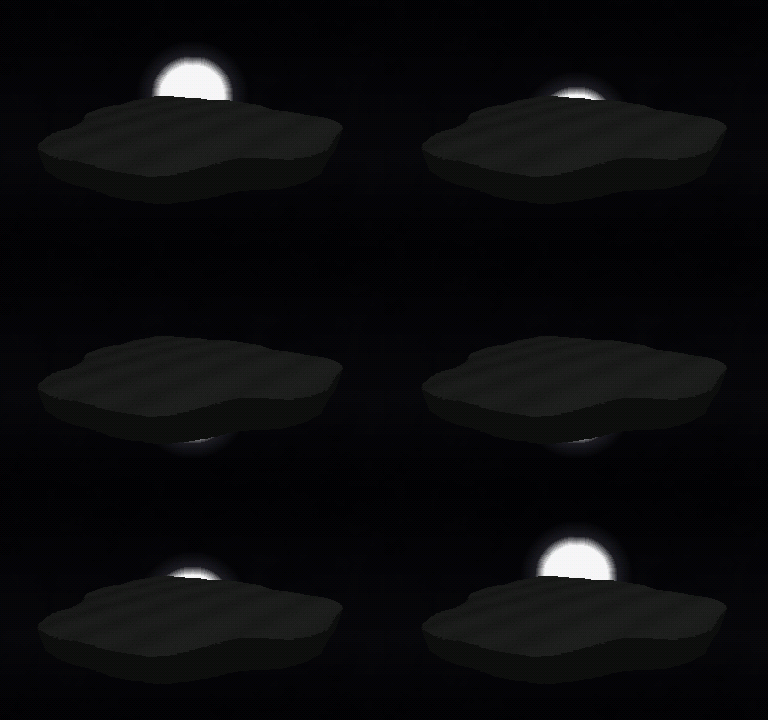
No air at all 384 × 240 (Z60) · 48-frame loop · shown at 3×
The same code with one number changed. Give the splat a hard saturated centre and the sun becomes a disc with a short skirt against a black sky. This is the control that shows the others are doing something.
subject=planet-sun-airless mode=Z60 384x240 single view, reference oracle (zref::render) frames=48 step=8 ticks (frame f: tick = f*step) programs: wave_pool hash=0x8BDCEB63 (27 instrs), impact_wave hash=0x82F5F4E4 (30 instrs) field_apps=0 stamps=0 debris=0 shake_frames=0 palette=108 unique colours (palette-exact by construction, <=256 enforced) NO atmosphere, same machinery: one number gives the splat a hard saturated core and the sun becomes a disc with a short skirt against an almost black sky. The control that shows the others are doing something sequence_crc32c=0x921A069F gif: 48 frames at 20 fps, 66,025 B, palette 108 of 256, paletteuse=dither=none (no palettegen) encode verified: decoded GIF matches every source frame byte-for-byte (CRC-32C cross-checked) inter-frame change: median 1.9% of pixels, max 3.3%, min 0.0%
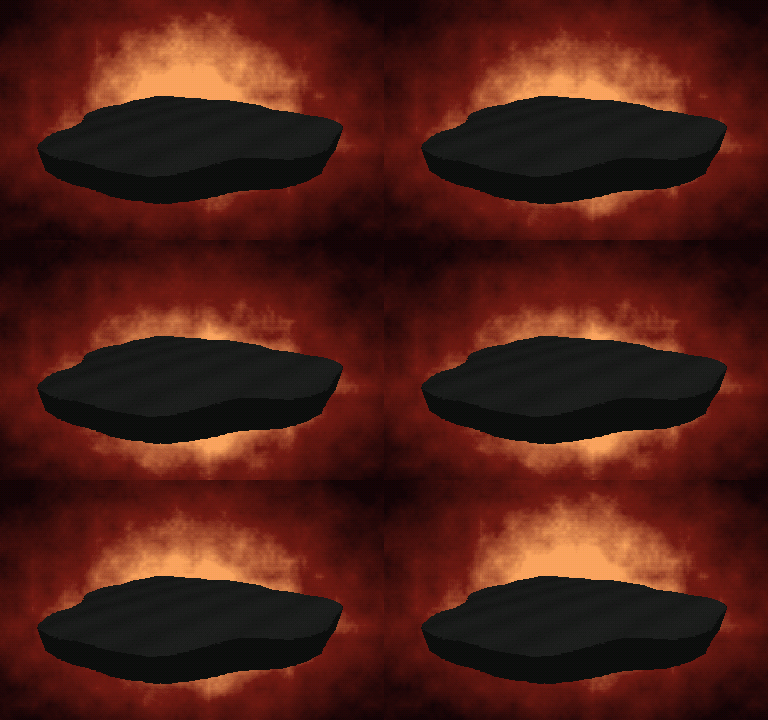
A red dwarf's world 384 × 240 (Z60) · 48-frame loop · shown at 3×
Dim and deep, and the sun never gets past orange because the brightest colour this sky owns is orange. Nothing tints the sun. There is nothing to tint.
subject=planet-sun-ember mode=Z60 384x240 single view, reference oracle (zref::render) frames=48 step=8 ticks (frame f: tick = f*step) programs: wave_pool hash=0x8BDCEB63 (27 instrs), impact_wave hash=0x82F5F4E4 (30 instrs) field_apps=0 stamps=0 debris=0 shake_frames=0 palette=120 unique colours (palette-exact by construction, <=256 enforced) a red dwarf's world: dim and deep, and the sun never gets past orange because the ramp's peak entry is orange. Nothing tints the sun; there is nothing to tint sequence_crc32c=0xE4A93123 gif: 48 frames at 20 fps, 1,044,161 B, palette 120 of 256, paletteuse=dither=none (no palettegen) encode verified: decoded GIF matches every source frame byte-for-byte (CRC-32C cross-checked) inter-frame change: median 22.0% of pixels, max 27.6%, min 0.0%
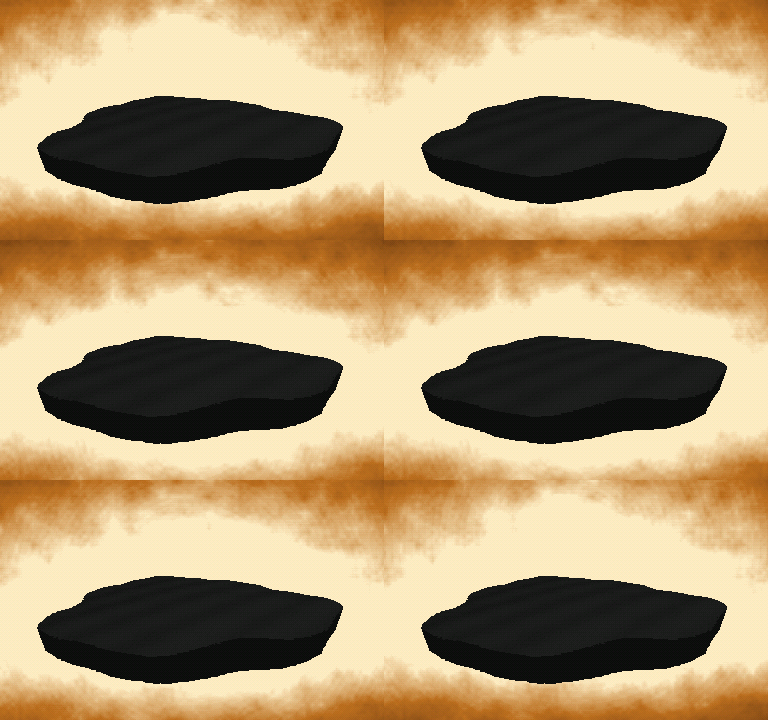
An amber giant, close 384 × 240 (Z60) · 48-frame loop · shown at 3×
Close enough that the glow is larger than the frame and the sky never goes dark anywhere.
subject=planet-sun-giant mode=Z60 384x240 single view, reference oracle (zref::render) frames=48 step=8 ticks (frame f: tick = f*step) programs: wave_pool hash=0x8BDCEB63 (27 instrs), impact_wave hash=0x82F5F4E4 (30 instrs) field_apps=0 stamps=0 debris=0 shake_frames=0 palette=117 unique colours (palette-exact by construction, <=256 enforced) an amber giant close enough that the bloom is larger than the frame. The sky never goes dark anywhere, and because the sun IS the sky ramp's peak entry this costs no colours at all. The same picture built from a sprite over a gradient would not fit the palette law sequence_crc32c=0xF4C0DB5D gif: 48 frames at 20 fps, 855,720 B, palette 117 of 256, paletteuse=dither=none (no palettegen) encode verified: decoded GIF matches every source frame byte-for-byte (CRC-32C cross-checked) inter-frame change: median 24.4% of pixels, max 28.9%, min 0.0%
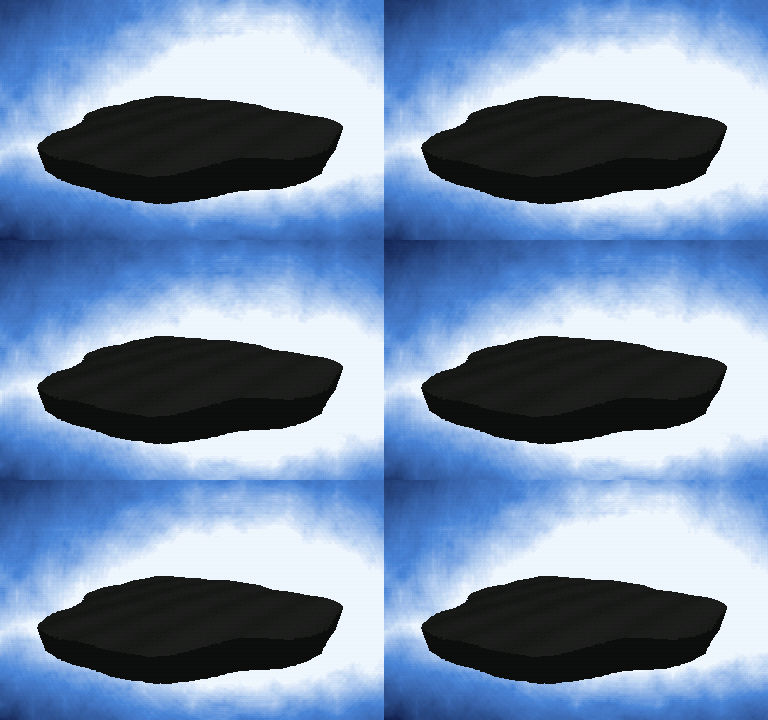
A blue supergiant 384 × 240 (Z60) · 48-frame loop · shown at 3×
The brightest entry is near white, so the core reads as glare rather than as a coloured object, while the sky it burns into stays unmistakably blue.
subject=planet-sun-supergiant mode=Z60 384x240 single view, reference oracle (zref::render) frames=48 step=8 ticks (frame f: tick = f*step) programs: wave_pool hash=0x8BDCEB63 (27 instrs), impact_wave hash=0x82F5F4E4 (30 instrs) field_apps=0 stamps=0 debris=0 shake_frames=0 palette=156 unique colours (palette-exact by construction, <=256 enforced) a blue supergiant. The ramp's peak is near white, so the core reads as glare rather than as a coloured object, while the sky it saturates into stays unmistakably blue sequence_crc32c=0x2514843B gif: 48 frames at 20 fps, 1,106,661 B, palette 156 of 256, paletteuse=dither=none (no palettegen) encode verified: decoded GIF matches every source frame byte-for-byte (CRC-32C cross-checked) inter-frame change: median 29.8% of pixels, max 36.3%, min 0.0%
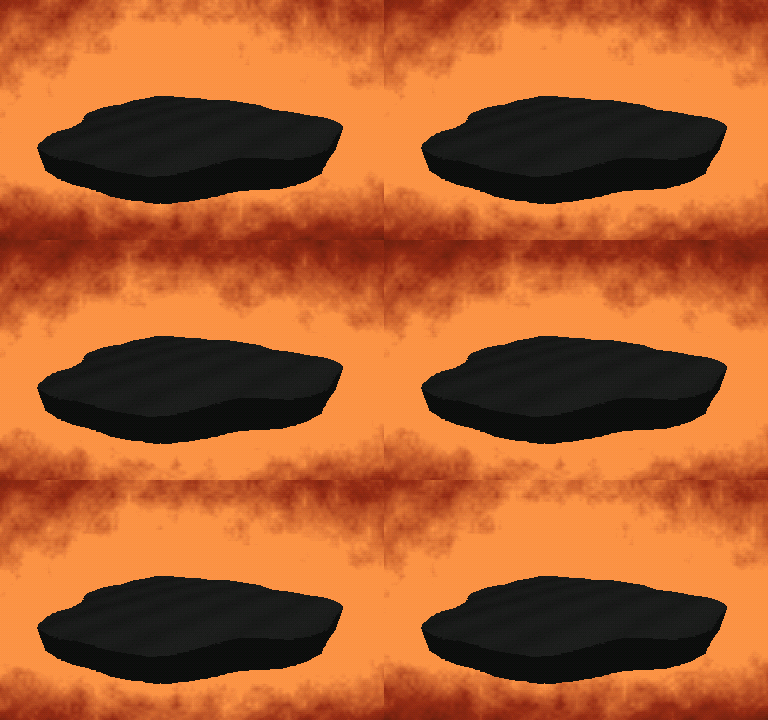
A swollen red giant 384 × 240 (Z60) · 48-frame loop · shown at 3×
The largest sun in the set. Nothing on this world is ever white: not the sun, not its glare, not the ground it lights. This loop also uses the fewest colours of any of the ten, because so much of the frame settles on one entry.
subject=planet-sun-redgiant mode=Z60 384x240 single view, reference oracle (zref::render) frames=48 step=8 ticks (frame f: tick = f*step) programs: wave_pool hash=0x8BDCEB63 (27 instrs), impact_wave hash=0x82F5F4E4 (30 instrs) field_apps=0 stamps=0 debris=0 shake_frames=0 palette=93 unique colours (palette-exact by construction, <=256 enforced) a swollen red giant over a dim world, the largest sun in the set at 480 px. The peak entry is orange, so nothing on this world is ever white -- not the sun, not its glare, not the ground it lights sequence_crc32c=0xFDC57719 gif: 48 frames at 20 fps, 843,741 B, palette 93 of 256, paletteuse=dither=none (no palettegen) encode verified: decoded GIF matches every source frame byte-for-byte (CRC-32C cross-checked) inter-frame change: median 24.0% of pixels, max 27.4%, min 0.0%
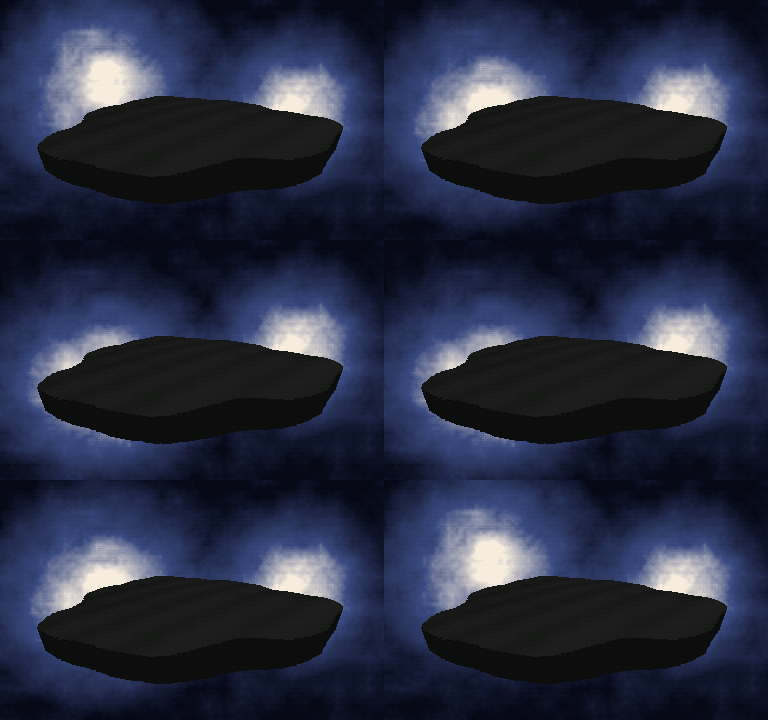
Two suns 384 × 240 (Z60) · 48-frame loop · shown at 3×
Both suns are added into the same picture and the overflow is simply cut off, so where the two glows meet they merge the same way one glow merges with itself. A second star costs nothing.
subject=planet-sun-binary mode=Z60 384x240 single view, reference oracle (zref::render) frames=48 step=8 ticks (frame f: tick = f*step) programs: wave_pool hash=0x8BDCEB63 (27 instrs), impact_wave hash=0x82F5F4E4 (30 instrs) field_apps=0 stamps=0 debris=0 shake_frames=0 palette=134 unique colours (palette-exact by construction, <=256 enforced) TWO suns. Both splats add into the same plane and the clamp resolves the overlap, so where the blooms meet the sum simply rails in the sky's own peak colour exactly as one bloom does against itself. A second star adds zero palette entries sequence_crc32c=0xA9D2C999 gif: 48 frames at 20 fps, 745,600 B, palette 134 of 256, paletteuse=dither=none (no palettegen) encode verified: decoded GIF matches every source frame byte-for-byte (CRC-32C cross-checked) inter-frame change: median 22.4% of pixels, max 26.8%, min 0.0%
A sun seen through thick air
Two loops of the same sun setting over the same island, from the same camera, with one number changed between them. Noctis IV is at its best when it puts a star behind a heavy atmosphere, and this is the console attempting the same thing. The pair is published together so the claim can be checked rather than taken on faith.
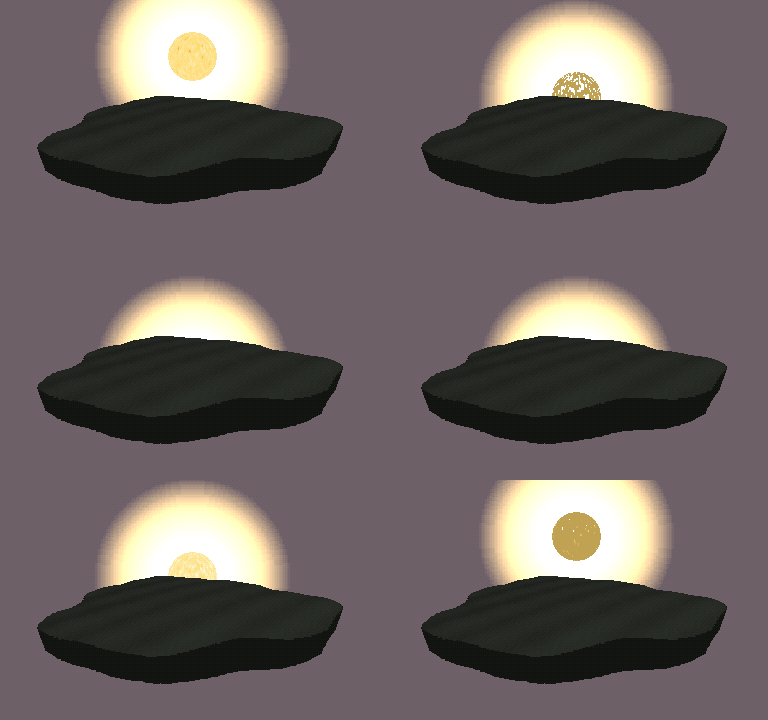
The ramp as carried over 384 × 240 (Z60) · 64-frame loop · shown at 3×
The corona here is the atmosphere variant of the halo bake, a plain glow ball with no bright core, drawn at four times the disc radius. The colour comes from the star ramp exactly as it was taken over from the original. That ramp's top control point deliberately over-ranges the clamp on all three channels, so the ramp whitens as it brightens. For a star seen through empty space that is right, and it is what makes the space classes in the catalogue above look the way they do.
subject=atmo-sun-donor mode=Z60 384x240 single view, reference oracle (zref::render) frames=64 step=8 ticks (frame f: tick = f*step) programs: wave_pool hash=0x8BDCEB63 (27 instrs), impact_wave hash=0x82F5F4E4 (30 instrs) field_apps=0 stamps=0 debris=0 shake_frames=0 palette=151 unique colours (palette-exact by construction, <=256 enforced) S00 sun setting through a thick atmosphere over the island; halo_atmo corona at 4x the disc radius, no lens chain. The ramp is the ported one: its top control point over-ranges the clamp on every channel, so the core whitens as it brightens. Pair this with atmo-sun-thick, which applies an atmospheric transmission to the same ramp and changes nothing else about the scene sequence_crc32c=0xD16723F6 gif: 64 frames at 20 fps, 361,750 B, palette 151 of 256, paletteuse=dither=none (no palettegen) encode verified: decoded GIF matches every source frame byte-for-byte (CRC-32C cross-checked) inter-frame change: median 9.6% of pixels, max 11.8%, min 0.0%
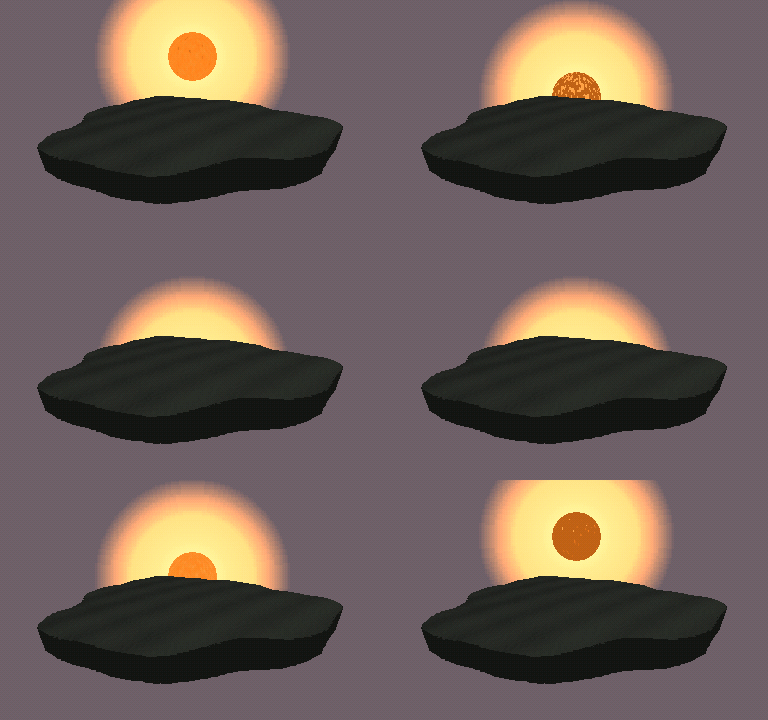
The same sun with the air put back 384 × 240 (Z60) · 64-frame loop · shown at 3×
Air thick enough to bloat a disc has already scattered the short wavelengths out of the path before the light arrives, so a low sun should go dimmer and redder, never whiter. The change is one per-channel transmission applied to the ramp's control points before the ramp is built: red passes, green is halved, blue is mostly gone. Nothing else in the scene moves, and the ramp law itself is untouched, so this costs three multiplies once when the palette is baked.
Reddening only the top of the ramp was tried first and turned out to be invisible. The corona falls off in a straight line from its centre, so the top of the ramp covers a few pixels out of a hundred, and the corona is added to what is behind it rather than replacing it, which rails every channel near the core whatever colour went in. The parts of a glow that decide how it reads are the middle and the edges.
Two things this pair does not yet do. The falloff is still a straight line, where the original has a long soft shoulder with no findable edge. And the sky layer has an elevation ramp but no term that brightens it around the sun, so here the corona is standing in for the glow the sky itself should carry. Both are written down rather than papered over. The sky is deliberately flat and close to neutral in these two loops, because a warm sky would have flattered the second one before the comparison started.
subject=atmo-sun-thick mode=Z60 384x240 single view, reference oracle (zref::render) frames=64 step=8 ticks (frame f: tick = f*step) programs: wave_pool hash=0x8BDCEB63 (27 instrs), impact_wave hash=0x82F5F4E4 (30 instrs) field_apps=0 stamps=0 debris=0 shake_frames=0 palette=152 unique colours (palette-exact by construction, <=256 enforced) the same sun, the same island, the same camera, with one number changed: a per-channel transmission (1.0, 0.60, 0.25) is applied to the ramp control points before the ramp is built, so red passes, green is halved and blue is mostly gone at EVERY intensity. Reddening only the ramp top was tried first and is invisible: the corona falls off linearly so the top governs a few pixels, and additive compositing rails every channel near the core regardless. The corona is built from the same ramp and follows without a second knob sequence_crc32c=0x08B5A606 gif: 64 frames at 20 fps, 394,499 B, palette 152 of 256, paletteuse=dither=none (no palettegen) encode verified: decoded GIF matches every source frame byte-for-byte (CRC-32C cross-checked) inter-frame change: median 10.1% of pixels, max 12.1%, min 0.0%
The star catalogue
The console carries a twelve-class star gamut taken over from Noctis IV with its exact colour tables, and the library now screens every live class. The six loops below are generated straight from the effects-library catalogue in the repository: the same file pins each loop's checksum, so a listing here is a claim the repository can re-derive. The other three live classes appear above (the yellow flare sweep, the boiling red giant, the pulsar); the three dead classes have no flare and no screen by spec law. Every moving sun drags a smear behind it now: eight fading ghosts of its own corona, rebuilt from captured history each frame.
| Class | Name | Colour | Library status |
|---|---|---|---|
| S00 | Yellow star | 255, 235, 162 | screened · crc 0xA4480FB8 |
| S01 | Blue giant | 121, 203, 255 | screened · crc 0xC38E703C |
| S02 | White dwarf | 255, 255, 255 | screened · crc 0x61C32E3A |
| S03 | Red giant | 255, 121, 81 | screened · crc 0xADC6EB7C |
| S04 | Orange giant | 255, 223, 130 | screened · crc 0x0C35E965 |
| S05 | Brown dwarf | 130, 65, 40 | dead class · no flare, no screen (spec law) |
| S06 | Grey giant | 130, 113, 97 | dead class · no flare, no screen (spec law) |
| S07 | Blue dwarf | 40, 81, 255 | screened · crc 0xBA485DBA |
| S08 | Multiple | 255, 130, 65 | screened · crc 0x1AB97077 |
| S09 | Infant star | 195, 130, 255 | screened · crc 0x24BCEDD2 |
| S10 | Runaway | 162, 40, 40 | dead class · no flare, no screen (spec law) |
| S11 | Pulsar | 0, 255, 255 | screened · crc 0x6F2A61FC |
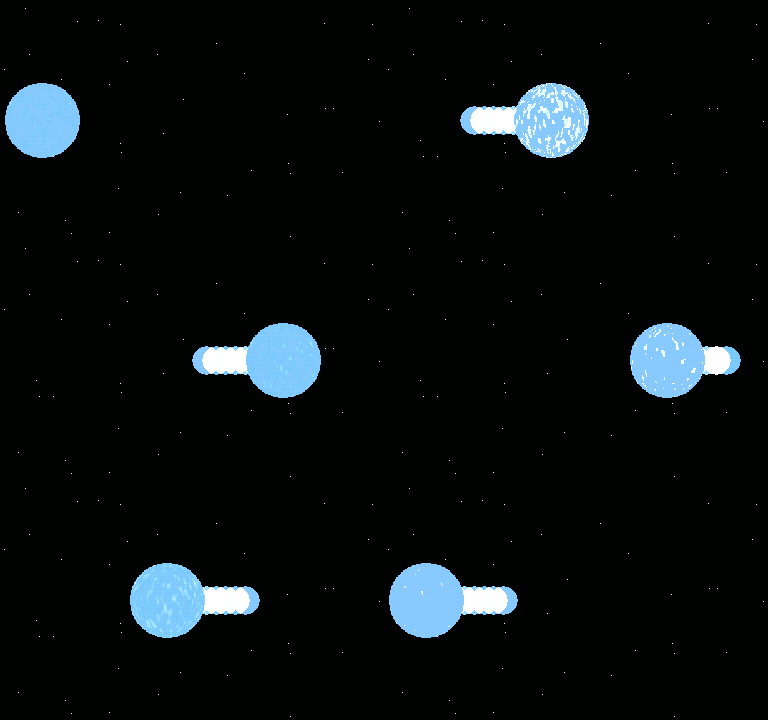
Blue giant 384 × 240 (Z60) · 64-frame loop · shown at 3×
Large hot star, bright blue-white (30,50,63). Drifts with a smear: white-hot streak, blue fringe.
subject=blue-giant mode=Z60 384x240 single view, reference oracle (zref::render) frames=64 step=8 ticks (frame f: tick = f*step) programs: wave_pool hash=0x8BDCEB63 (27 instrs), impact_wave hash=0x82F5F4E4 (30 instrs) field_apps=0 stamps=0 debris=0 shake_frames=0 palette=125 unique colours (palette-exact by construction, <=256 enforced) S01 blue giant at 20 radii; large hot star with bright blue-white colour (30,50,63 VGA); compact corona and burst flare sequence_crc32c=0xE1CB9DA8 gif: 64 frames at 20 fps, 402,300 B, palette 125 of 256, paletteuse=dither=none (no palettegen) encode verified: decoded GIF matches every source frame byte-for-byte (CRC-32C cross-checked) inter-frame change: median 10.9% of pixels, max 14.2%, min 5.0%
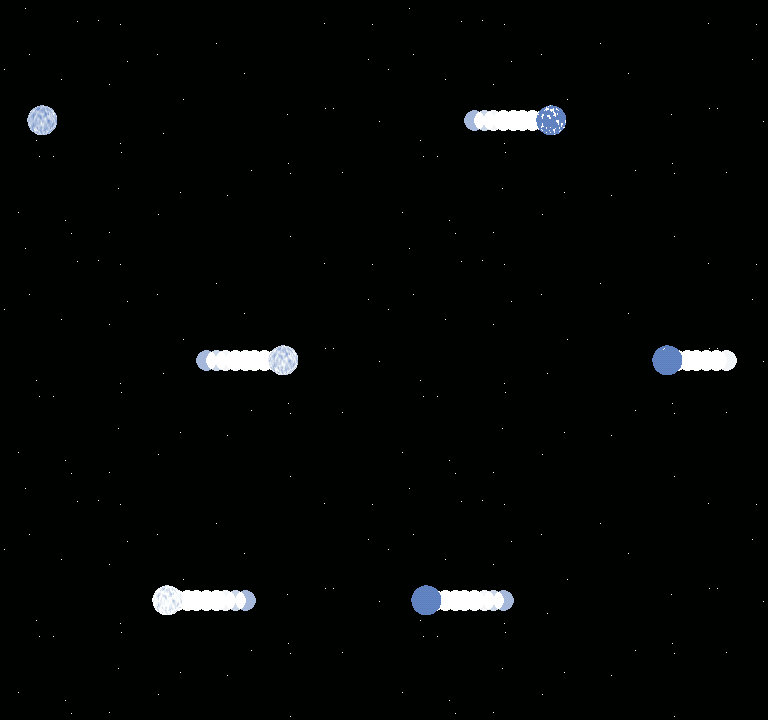
White dwarf 384 × 240 (Z60) · 64-frame loop · shown at 3×
Compact white star (63,63,63), rapid spin, fine granulation. Small star, long smear.
subject=white-dwarf mode=Z60 384x240 single view, reference oracle (zref::render) frames=64 step=8 ticks (frame f: tick = f*step) programs: wave_pool hash=0x8BDCEB63 (27 instrs), impact_wave hash=0x82F5F4E4 (30 instrs) field_apps=0 stamps=0 debris=0 shake_frames=0 palette=133 unique colours (palette-exact by construction, <=256 enforced) S02 white dwarf at 2 radii; compact white star (63,63,63) with rapid spin; five-pass box-smooth granulation; drifts with a long smear sequence_crc32c=0x227942AE gif: 64 frames at 20 fps, 131,549 B, palette 133 of 256, paletteuse=dither=none (no palettegen) encode verified: decoded GIF matches every source frame byte-for-byte (CRC-32C cross-checked) inter-frame change: median 3.3% of pixels, max 4.0%, min 1.4%
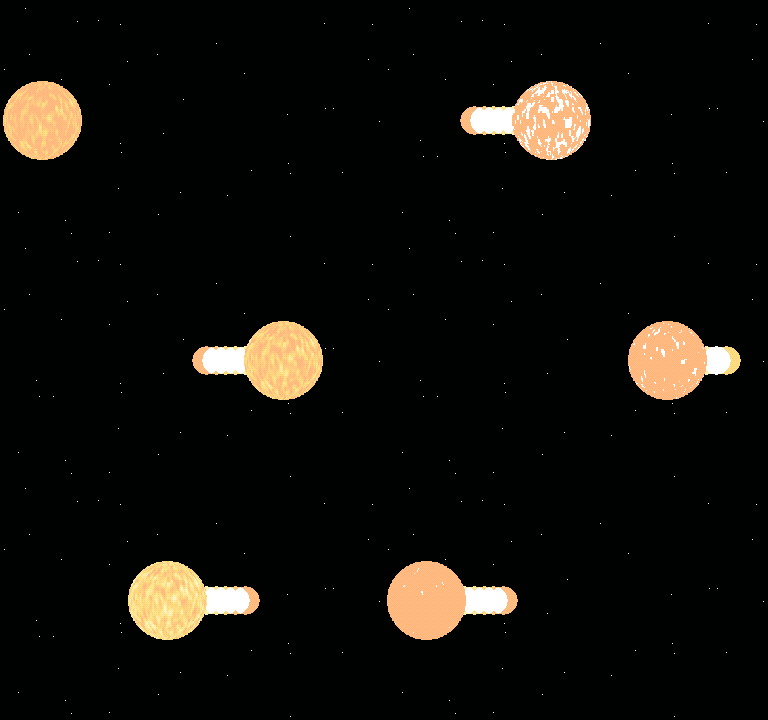
Orange giant 384 × 240 (Z60) · 64-frame loop · shown at 3×
Warm giant, golden orange (63,55,32). Drifts with a connected graded smear that fades to orange at the fringe.
subject=orange-giant mode=Z60 384x240 single view, reference oracle (zref::render) frames=64 step=8 ticks (frame f: tick = f*step) programs: wave_pool hash=0x8BDCEB63 (27 instrs), impact_wave hash=0x82F5F4E4 (30 instrs) field_apps=0 stamps=0 debris=0 shake_frames=0 palette=160 unique colours (palette-exact by construction, <=256 enforced) S04 orange giant at 2.5 radii; warm giant star with golden orange colour (63,55,32); drifts with a white-hot smear fading to orange at the fringe sequence_crc32c=0xF76001F9 gif: 64 frames at 20 fps, 415,976 B, palette 160 of 256, paletteuse=dither=none (no palettegen) encode verified: decoded GIF matches every source frame byte-for-byte (CRC-32C cross-checked) inter-frame change: median 10.9% of pixels, max 15.2%, min 6.2%
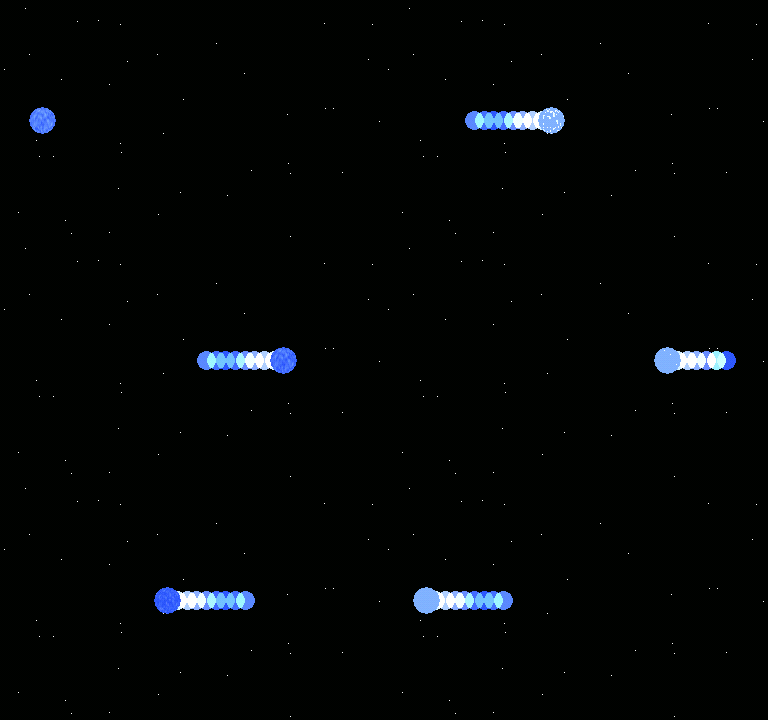
Blue dwarf 384 × 240 (Z60) · 64-frame loop · shown at 3×
Compact deep blue star (10,20,63). The connected asymmetric smear grades into a deep blue tail.
subject=blue-dwarf mode=Z60 384x240 single view, reference oracle (zref::render) frames=64 step=8 ticks (frame f: tick = f*step) programs: wave_pool hash=0x8BDCEB63 (27 instrs), impact_wave hash=0x82F5F4E4 (30 instrs) field_apps=0 stamps=0 debris=0 shake_frames=0 palette=188 unique colours (palette-exact by construction, <=256 enforced) S07 blue dwarf at 2 radii; compact deep blue star (10,20,63); the drift smear grades white to deep blue along the tail sequence_crc32c=0xEBCA7820 gif: 64 frames at 20 fps, 127,644 B, palette 188 of 256, paletteuse=dither=none (no palettegen) encode verified: decoded GIF matches every source frame byte-for-byte (CRC-32C cross-checked) inter-frame change: median 3.1% of pixels, max 4.1%, min 1.1%
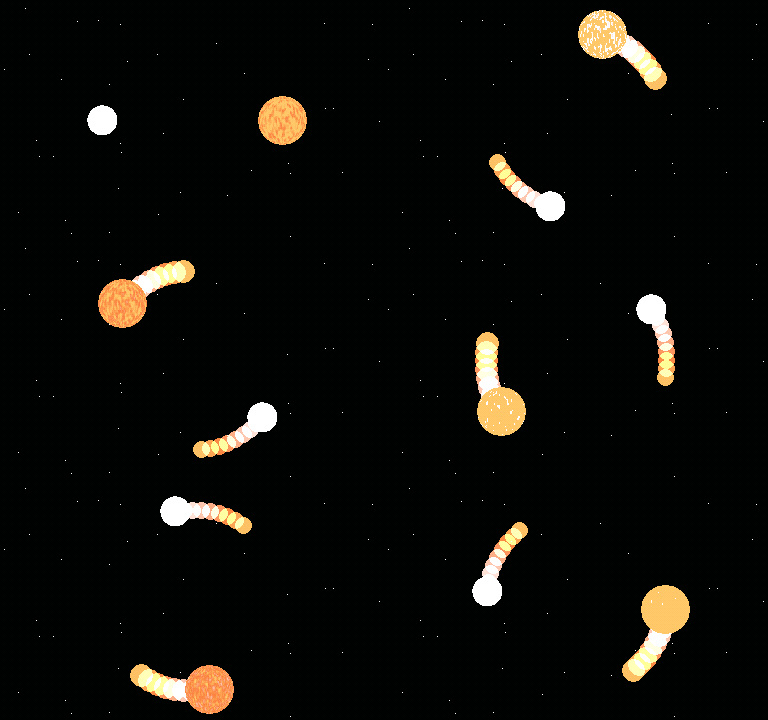
Multiple 384 × 240 (Z60) · 64-frame loop · shown at 3×
Binary system: two bodies of one class orbit the barycentre once per loop, curved trails on both.
subject=multiple mode=Z60 384x240 single view, reference oracle (zref::render) frames=64 step=8 ticks (frame f: tick = f*step) programs: wave_pool hash=0x8BDCEB63 (27 instrs), impact_wave hash=0x82F5F4E4 (30 instrs) field_apps=0 stamps=0 debris=0 shake_frames=0 palette=204 unique colours (palette-exact by construction, <=256 enforced) S08 multiple system: two bodies of one class orbiting the barycentre, one revolution per loop, each with a curved trail (the §15 showpiece) sequence_crc32c=0xCC14D30A gif: 64 frames at 20 fps, 526,314 B, palette 204 of 256, paletteuse=dither=none (no palettegen) encode verified: decoded GIF matches every source frame byte-for-byte (CRC-32C cross-checked) inter-frame change: median 11.0% of pixels, max 14.0%, min 3.8%
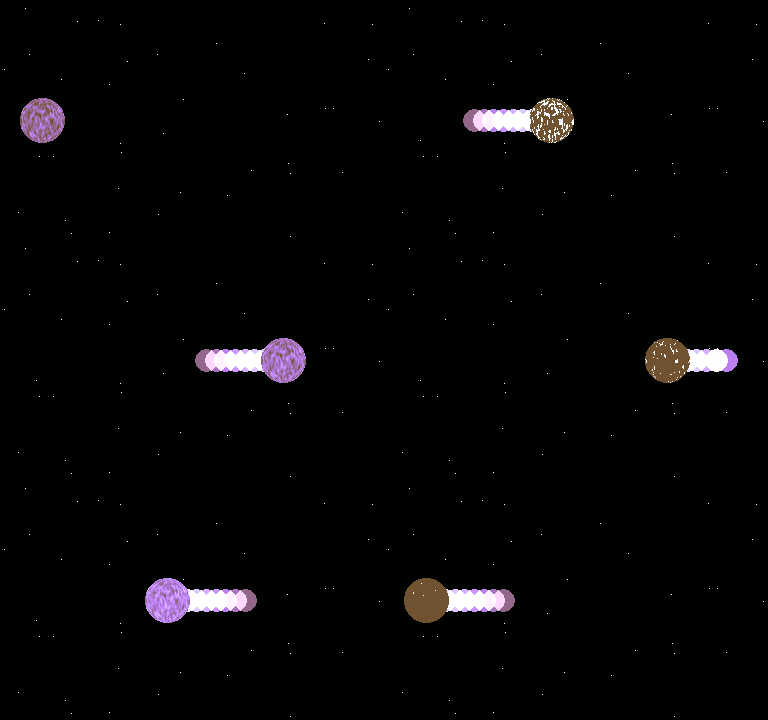
Infant star 384 × 240 (Z60) · 64-frame loop · shown at 3×
Young protostar, purple (48,32,63), per-identity undertone. Drifts with a purple smear.
subject=infant mode=Z60 384x240 single view, reference oracle (zref::render) frames=64 step=8 ticks (frame f: tick = f*step) programs: wave_pool hash=0x8BDCEB63 (27 instrs), impact_wave hash=0x82F5F4E4 (30 instrs) field_apps=0 stamps=0 debris=0 shake_frames=0 palette=160 unique colours (palette-exact by construction, <=256 enforced) S09 infant star at 2 radii; young protostar, purple (48,32,63), per-identity undertone; drifts with a purple smear sequence_crc32c=0x91F8EB1A gif: 64 frames at 20 fps, 228,233 B, palette 160 of 256, paletteuse=dither=none (no palettegen) encode verified: decoded GIF matches every source frame byte-for-byte (CRC-32C cross-checked) inter-frame change: median 5.8% of pixels, max 7.5%, min 2.6%
Untouched native-resolution copies of the stills live under
renders/native/. The dated, append-only diary of renders is the next
section: what the machine looked like then, beside what it looks like now.
03 · DIARYWhat the machine looked like, and when
The gallery above always shows a subject's current state. This diary is the half that never changes: an entry is recorded once, on its date, and is never overwritten or deleted. Each group below follows one subject, newest first, and links back to that subject's current render in the gallery. Because every capture is deterministic, an entry is also a regression artifact: a loop that has drifted no longer matches its recorded self.
terrain-breach
1 entry · 2026-08-16 · See this subject's current render in the gallery.
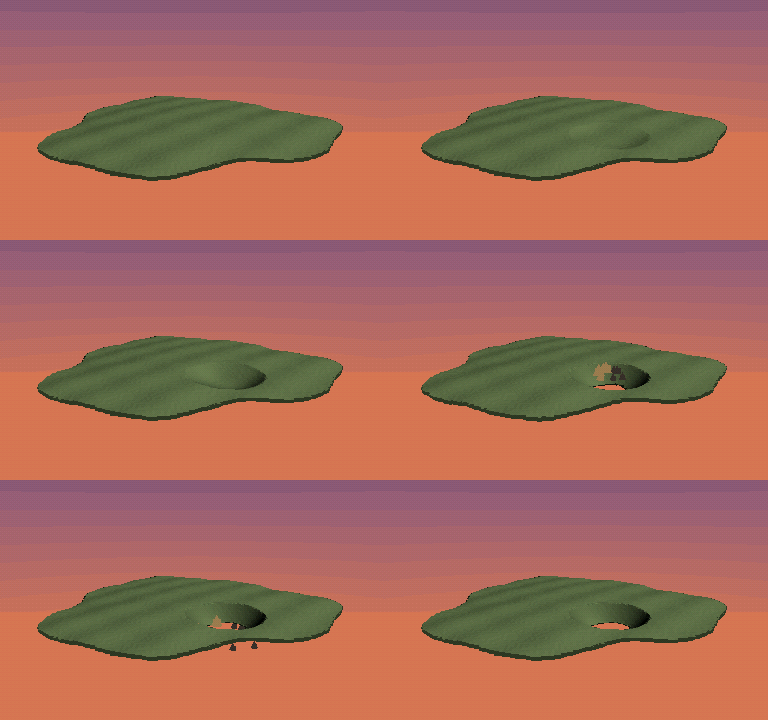
2026-08-16 · flat island 384 × 240 (Z60) · 64-frame loop · shown at 3×
The breach captured while the island was still a flat 22 m sheet with flat-shaded colour surfaces. The dig met the thin underside quickly and debris left the world almost at once; the current gallery loop digs 84 m through a 75 m keel of banded, textured rock.
flare-occlusion
1 entry · 2026-08-16 · See this subject's current render in the gallery.
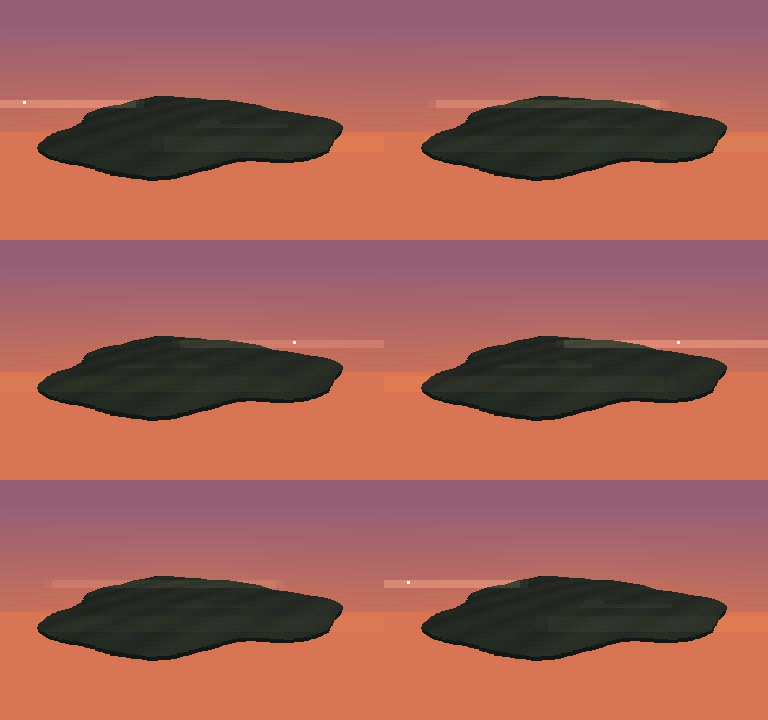
2026-08-16 · flat island 384 × 240 (Z60) · 64-frame loop · shown at 3×
The occlusion fade captured against the flat 22 m island, before the keel and before surfaces were textured. The current gallery loop runs the same fade against the deep, textured island.
04 · STATUSWhere the project actually is
Every number below was read out of the repository at a pinned commit. Nothing is rounded up, and the zeroes are as load-bearing as the rest.
The maturity ladder
The design is split into 88 blocks: 73 hardware, 15 software. Every block climbs a seven-rung ladder one rung at a time, and each advance must cite evidence that a validator re-checks against git history. Nothing is on the top three rungs, because those require a physical board, and there is none.
The fourteen blocks at RTL_VERIFIED are the whole console shell: command
scheduling and DMA, the memory arbiter, guard and bridge, the video pipeline, input, audio,
and the debug counters and per-frame checksums, each verified in simulation against its C++
reference. The thirty-three at UNIT_VERIFIED are the drawing machine and the
world it draws: the five rasterizer blocks, the texture units and cache, the geometry front
that clips and bins a triangle, the terrain blocks, the persistent damage store, the
creature skinning block, the vertex projector, two particle blocks and the trace ring. That
rung means the circuit design and the C++ reference agree on every case a test could put to
them, in simulation. Six further blocks are marked blocked on hardware; the ledger
tool refuses to advance them until a board exists, no matter what evidence is offered.
The creature path now exists as circuits
The machine could draw a world, but not an animal moving in it. That path is now designed and checked in simulation from end to end: a packed quaternion becomes a rotation matrix, bone matrices chain down a skeleton, a whole skeleton pose is decoded from one animation clip and frame, a cache decides which poses are already decoded and which one to throw away, and skinning makes a creature's vertices follow its bones. Each piece is compared against the same C++ reference the images above come from.
Two decisions inside it are worth stating. The chain multiply is built to compute one element per cycle rather than all of them at once, and the whole decode chain shares a single multiply engine across every bone, because posing is not per-vertex work: a pose is decoded once for a given creature type, animation and frame, and then shared by every creature of that type on screen that frame. That sharing is the entire reason the cache exists. The cache block, in turn, decides which pose is needed and where it goes while deliberately not owning the memory it sits in, because how much of the chip's fast memory to spend on posing is a real decision, and burying it inside a module is how a budget gets spent without anyone choosing. Until that is decided the pose block stays marked unfinished, because two verified halves are not a finished block.
A vertex on screen, and a division that had to be exact
Turning a posed vertex into a pixel position needs a division, and the circuit has to give the same answer as the reference down to the last bit, including how it rounds negative numbers, where the obvious approach is subtly wrong. No reciprocal trick reproduces it, so the block carries a real thirty-one step divider, pipelined so it still retires one vertex per clock. Its declared reference did not exist when the work started; the law turned out to be shipped under another name, already proven by the terrain block that uses it.
Around it, a run of smaller blocks landed the same way: the trace ring that records what the machine did for later inspection, the store that holds the scars burned into the ground, the two terrain blocks that bake a program's output into the surface and read velocity back out of it, a cache that keeps validated spell programs resident, and the two ways a particle becomes something drawable, a triangle when it is large and a point sprite when it is small.
The scar store had working circuitry and a green test suite for months and still could not advance, because the ledger looked at its test and called it an alias rather than evidence. It was right: the test imported the reference model, named it, and never called it, so it checked that the block agreed with itself. The replacement runs both over one stream of operations and makes them agree on every texel of a patch. The law it defends is the one the block exists for, that re-acquiring a patch does not wipe it. A version that cleared on every acquire passes any test that writes and reads in one go, and erases the world between frames.
The spell-program engine
Terrain programs and spells are compiled bytecode, and so far only software has been able to run them. The engine that will run them in hardware is under construction, and four parts of it are built and checked: an arithmetic core covering fifteen operations (add, multiply, compare, clamp, dot product and the rest) over 300,000 random cases; a reciprocal, which needs a 256-entry table and a correction step, over 150,000; sine and cosine, checked exhaustively, because an angle here is a 16-bit count of turns, so all 65,536 of them were compared for both functions, which makes that one a proof rather than evidence; and length and distance, resting on an exact integer square root done as binary longhand rather than an approximation, because a program's lengths have to match the software's at every input.
Both tables are generated from the reference by a script instead of being typed in, and then checked entry by entry, because a wrong constant would not fail loudly. It would put a few angles slightly off. An operation the engine cannot yet perform refuses rather than returning zero, because a quiet zero would let it run a spell it cannot actually evaluate and everything would look fine.
One engine unblocks five blocks, which is why it is the next substantial thing being built. The specification forbids a second implementation of the instruction set anywhere in the project, so this is a bytecode engine that executes the same program images the software interpreter reads, verified against that interpreter, rather than an evaluator written by hand from the prose.
What is left, and who it is waiting on
Every remaining block was trial-advanced one at a time and its objections written down, so the remainder is known rather than estimated. Two supplies have now run out: work that was finished but merely unrecorded, and blocks whose law was already written somewhere under a different name. The thirty-seven that remain split three ways.
- Waiting on a specification another part owns. The compressed vertex format has two ends and the packing end belongs to the asset tools. Inventing one end alone would create exactly the kind of unratified law this project keeps catching.
- Waiting on the spell-program engine. Five blocks, one engine, the one described above. Large, unambiguous, and needing nothing from anyone.
- Waiting on a decision about how the game behaves. Roughly a dozen blocks: how a particle spawns, ages and collides; what bloom and heat haze look like; what the interface sprite pipeline does. There is no software to copy and no ratified specification section to follow, so building them means choosing the behaviour first and recording that choice as the reference.
Finishing the hardware is therefore not one more sitting's work, and the page would rather say so than let a rising count imply otherwise.
Phase 2 closed: the console runs as one machine
Before Phase 2, every verified block had only ever been tested alone. Phase 2 composed them into one running machine: publish a sealed frame packet and the console fetches it, schedules it, copies the pixels, swaps buffers, scans out, and reports a per-frame checksum and counters, with no test scaffolding in the datapath. In the gate demo, two controllers move markers across a split-screen world through the real input path, and every one of 1,202 displayed frames matched the independent C++ reference over every byte. A randomized 10,000-frame soak (two and a half hours of simulated play) passed 205,026 checks with zero failures.
Composing the blocks revealed defects no per-block test could see: a data seam that silently carried only an eighth of each memory write, while its test compared exactly the eighth that survived; a deadlock between two blocks that are each correct alone; and both framebuffers sharing one DRAM bank, which shredded the display under real combined traffic. All three are fixed and pinned by tests.
The gate also measured that copying a finished frame off the machine for checking takes just under two frames, so debug captures run at 30 Hz. That number is the cost of the debug copy, not how fast the console draws.
Phases
The charter defines fourteen phases, each with a hard acceptance gate. Two have written, ratified gate reports.
The one outstanding Phase-1 gate (a tiny program in the console's own language parses, type-checks and compiles) was deferred into Phase 3, in writing, and Phase 3 is now underway. The amber marks on Phases 6 to 10 mean blocks belonging to that phase are verified in simulation, and nothing more: none of those phases has a written gate report, and no phase above 2 has been closed.
Tests and proofs
The fast gate every change must pass currently runs 214 tests with zero failures, having risen from 180 over one day of work. Beyond it: long randomized nightly soaks, dedicated memory and video lanes, and 216 compiler test cases. Excluding generated code, the hardware description is about 29,900 lines of SystemVerilog, beside 27,800 lines of TypeScript, 23,700 lines of C++ reference, runtime and tools, and 46,900 lines of C++ tests.
Ten properties are registered for formal proof, which is mathematical model-checking rather than testing. One of them is worth retelling. The memory arbiter's fairness bound was frozen at 40 cycles and cited as evidence for a full development wave, but the proof had never actually been run. The moment it was made real, 40 failed. The bound was re-derived from the actual burst arithmetic and then proven exactly tight: the proof fails at 51 cycles and passes at 52, so 52 is the true worst case rather than a number that happened to pass. The old formula stays in the spec, struck through, so the error remains visible. One property, the memory-refresh bound, is not established: its full proof does not finish on this machine, so it is excluded from the automated lane and recorded as unfinished.
First synthesis
Synthesis now reaches the console itself, one block at a time. Thirteen of the shell's eighteen blocks have been placed and routed on a stand-in Cyclone V part, and they come to 4,096 ALMs between them, roughly a tenth of that device. The largest single block measured is the command scheduler at 815; the smallest is the video mode decoder at 70. Five blocks did not fit and are recorded as failures rather than estimated: four ran past their time budget and one was stopped after asking for 28 GB of memory on a machine with 24.
That last number has since moved. Composing the whole shell used to commit 28.4 GB against 24 GB of memory and thrash at near-zero processor use until it was killed, so there was no composed run at all. Two staging memories were restructured, and analysis and synthesis of the composed shell now runs to completion and stops with a precise complaint instead: the toolchain names two memories it could not turn into RAM blocks, because both are read asynchronously, and reports that the registers left over exceed the device. One of the two was not known to have that defect until the tool said so. There is still no composed resource figure and none is guessed at, but the obstacle is now a named fault with a route through it rather than a machine that could not hold the problem.
No block is marked SYNTHESIZED. The device is a stand-in until a board is
probed, every input and output in these runs is virtual, and a per-block fit says nothing
about how the composed machine would route or close timing. There is no timing-closure data
and no bandwidth data; those directories exist and are empty on purpose.
05 · BLOCKEDWhat needs physical hardware
The repository keeps a written list of everything it cannot honestly do without a board, and refuses to guess any of it.
- Board truth. Real memory timings, measured bandwidth, clock stability, input latency. The file meant to hold these measurements does not exist, by design. No probe result has ever been simulated or assumed.
- The MiSTer platform layer is not vendored yet, which blocks the clock, reset and clock-domain-crossing blocks.
- Timing closure, and resource figures for the composed machine. Individual blocks are now being placed and routed by Quartus against a stand-in device, which is where numbers like 70 ALMs for the video mode decoder or 222 for the audio FIFO come from. The whole shell is a different matter: composing it used to exceed this machine, at 28.4 GB of memory against 24 GB available, and now runs through analysis and synthesis only to stop on a named inference fault. Either way there is no composed-machine figure and none is guessed at. The real chip stays unknown until a board is probed, so every number here is a stand-in and no timing claim is made at all.
- The top three maturity rungs, for all 73 hardware blocks.
- The long soak tests: eight and twenty-four hours of combined stress on real silicon. Not runnable, and explicitly not simulated.
And what simply is not built yet
- The Wound Lab demo is barely begun. The charter specifies a full scene: an island, two player wizards, three creature species, four spells. What exists is its first thin slice, the Phase-2 gate demo: two controllers moving markers on the composed machine. The sigils in the renders above are 8×8 test patterns standing in for wizards.
- The hardware rasterizer exists in RTL, and has never run on a chip. All five of its blocks are written and each is checked against the C++ oracle it must match: the edge walker, the tile store, early-Z, the fragment pipeline and the RGB565 resolve, plus the composition that wires them into one triangle-to-framebuffer path. The texture cache and the sampler are written too, and so is the geometry front that clips a triangle, sets up its edges and sorts it into tile lists, which then drive that rasterizer for real rather than by hand. Three arithmetic cores carry machine-checked proofs. That is simulation and proof, not silicon: none of it has been synthesized as a composed machine and none of it has been programmed onto a device. Every image on this page still came from the software renderer, and no picture here was produced by that RTL.
- What is designed and what is still absent. The creature animation path is designed and checked in simulation, and so are the geometry front, the vertex projector, the terrain blocks, the persistent damage store and two of the seven particle blocks. Still absent entirely: particle simulation, the compositor, the interface sprite pipeline, and the hardware engine that will run terrain and spell programs. The pose block is deliberately marked unfinished even though both of its halves are verified, because the memory it should use has not been chosen. None of this has been synthesized or run.
06 · METHODHow it is being built
The interesting part of this project is not the renderer. It is the rule that nothing is allowed to exist as hardware until it already exists as something testable.
Every hardware block must have, before any circuit is written: an executable reference implementation, directed tests, randomized tests that compare the circuit against that reference, and formal proofs where a property can be stated. The command format is generated from a single definition into C++, TypeScript and SystemVerilog, and the three are held byte-identical by a test that fails on any drift. There is no floating-point math anywhere in the render path; the software renderer is integer-only precisely so hardware can match it exactly.
The part that is easy to get wrong
Comparing two implementations catches disagreement. It cannot catch a mistake they share. Adversarial review rounds, reading the code against the frozen specification, have repeatedly found real bugs while the entire test suite was green:
A 65,536× amplification in a curve instruction. Both the C++ and TypeScript interpreters made the identical mistake, so the test comparing them agreed perfectly, on the wrong answer.
An invisible sun. A brightness conversion overflowed so that full brightness wrapped around to zero: any sun above a third of maximum energy drew exactly nothing.
A sky that silently did not exist. A shift bug collapsed all 48 columns of the sky cylinder to a single angle, turning every one of its 1,536 triangles into zero-area slivers the rasterizer dropped. The tests counted primitives and checked coordinates; none of them ever asked whether a pixel had been drawn. The fix ships with an assertion that does: zero sky pixels before, 371 after.
White that resolved to magenta. The display dither adds a small offset before quantizing each colour channel, and for green the offset can push full brightness one step past the top of its 6-bit field, which wraps to zero. The comment in the code proved the overflow impossible for red and blue and assumed green behaved the same; green's dither is twice as strong and its headroom half. Nothing in the project had ever produced saturated pure white until the new sun did, and the sun promptly resolved to a white-and-magenta checkerboard. The clamp is now law and a test drives every dither phase of every near-white green.
Formal proofs that had never run. Two blocks carried "formally proven" badges resting on proofs the tool had never once elaborated; they passed vacuously. When the lane was made real, both failed immediately, and fixing one of them surfaced a genuine hole in the memory protection. The rule that came out of it: a proof may not be cited as evidence unless the tool has recorded a passing run in which the assertions were demonstrably reachable.
Breaking the hardware on purpose
Every new block now ships with a mutation sweep: the circuit is deliberately broken in a list of specific ways, and the test suite has to notice each one. A test that stays green while the hardware is wrong is not evidence, and the only way to find that out is to make the hardware wrong. The sweep has caught something in most of the blocks built most recently, and in every case the test had been passing.
- The skinning block exists to round once, at the end, rather than twice along the way; double rounding is off by one in the last place, which reads on screen as a silhouette that shimmers as a creature moves. That law was defended by thirty-nine directed checks that a double-rounding version passed completely, because every matrix in them was built from whole numbers and rounding early threw nothing away. The replacement sweeps every blend weight against deliberately awkward values, and the broken version now fails hundreds of cases.
- The pose cache's eviction test could not tell "throw away the oldest" from "throw away the newest". It checked both groups, so a backwards cache produced the same totals with the roles swapped, and passed.
- A projection test could not tell whether the block was reading the right camera, because the two split-screen views happened to differ only vertically. A version that always read the first camera horizontally gave identical answers.
- Two sections of a cache test asked for animation frames past the end of the animation, so every request was correctly rejected and those sections tested nothing at all. They looked green the whole time.
The sweep also keeps catching prose rather than circuitry. Four claims written into comments about why something mattered turned out to be false when the matching mutation changed nothing: a division that never truncates, a shift whose signedness makes no difference at these widths, a rounding order that is exactly equal except at the extremes, and a guard against a hazard that was not there. None of the four changed the hardware, and all four would have misled whoever read the file next.
The lesson the project keeps re-learning, and keeps writing down: a green test suite is evidence about the tests, not about the machine. Counting triangles is not the same as checking that a pixel was written, and a proof that has never run is not a proof.